
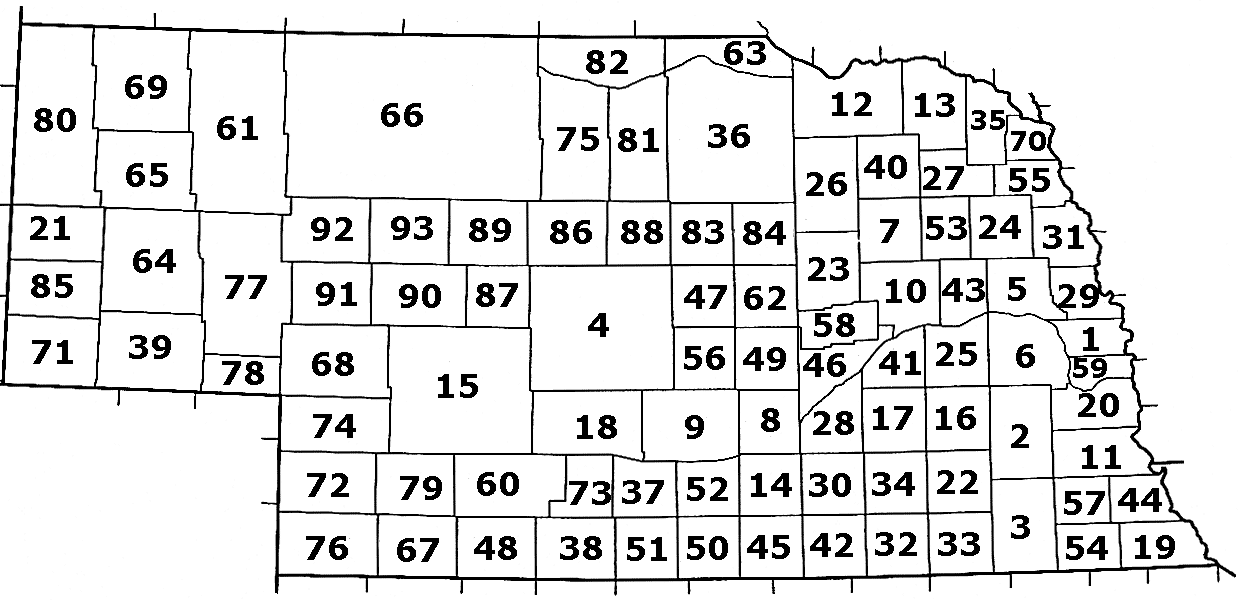
Every Nebraska license plate outside the three largest counties carries a number before the dash, and that number tells you which county the vehicle is registered in. A plate beginning 66 is a Cherry County vehicle. One beginning 4 is from Custer County. Below is what each of the 93 numbers means, listed both ways round — and, because it is the first thing people ask, why the order is not the one you would expect.
Every county on this map is a link — tap or click one to see its businesses, offices and towns. The number shown is the county number that appears on the plate.
Where the numbers come from
The system began in 1922. The Nebraska Department of Public Works gave each county a number and, contrary to what nearly everyone in the state is told at some point, it did not rank them by population. It ranked them by how many motor vehicles were registered in each county.
In 1922 those two things pointed in different directions. A town with a railway depot, a streetcar line and shops you could walk to did not need a car for every family. A farm twenty miles from the nearest town did. So the rural counties ran a far higher ratio of automobiles to people than the cities did, and the 1922 list reflects it. It is not a ranking of where Nebraskans lived. It is a ranking of where Nebraskans drove.
That single fact explains most of what looks wrong about the order. Custer County sits at 4, ahead of counties many times its size today, because in 1922 it was a very large county thick with farm vehicles. Sarpy County sits at 59, though it is now the third most populous county in the state, because in 1922 it was quiet farmland south of Omaha and Offutt Air Force Base did not yet exist.
The numbers have never been renumbered since. A county number assigned in 1922 is the same number on the plate today, which makes the list a snapshot of where Nebraska kept its cars a century ago. Douglas, Lancaster and Sarpy no longer display theirs — state law moved counties over 100,000 people to a three-letter system in 2002 — but they still hold 1, 2 and 59 in the statute.
Nebraska county numbers, 1 to 93
Read the number before the dash on the plate, then find it here. Each county name links through to that county’s businesses, offices and towns in the directory.
The same list, by county name
If you know the county and want its number.
How far the numbers have drifted
Custer and Sarpy are the sharpest examples, but others drifted a long way too. Scotts Bluff holds 21 and would rank around seventh today. Dakota County holds 70 and would rank around sixteenth. Boone County holds 23 and would be closer to forty-sixth. One count done on vehicle registrations in 2021 found only five counties still sitting in their original position: Douglas, Lancaster, Saline, Wheeler and Thomas.
Why the number is still in use
In a rural county the prefix tells you something at a glance: where a vehicle is registered. Traditionally that was read off an approaching car, and on a road where most people know most people it was part of knowing who you were meeting. That habit is lighter than it used to be, but the number is still the quickest way to place a vehicle, and it is still how people say where they are from — a 66 plate means Cherry County to anyone who lives there.
In the metropolitan counties it does less work, and that is the practical reason the system ended up split. When the Legislature considered moving the whole state to the alphanumeric system, the compromise reached in 2001 kept the numbers in the ninety counties that use them and dropped them in the three largest — Douglas, Lancaster and Sarpy.
Which plates do not have a number
Three kinds of Nebraska plate will not give you a county this way.
- Douglas, Lancaster and Sarpy Counties. State law requires any county over 100,000 people to use the alphanumeric system instead — three letters, then numbers. Those three stopped displaying their county numbers in January 2002, although they still hold 1, 2 and 59 in the statute. Any other county may switch to alphanumeric if its county board decides to.
- Personalized and message plates. These are issued in sequence across the whole state, so they carry no county number at all.
- Most specialty plates. The county is recorded on the application, but it does not appear on the plate.
A few things people ask
Has a county number ever changed?
No. The numbers assigned in 1922 are the numbers today. There was one interruption: for the 1951 plate year only, Nebraska replaced the numbers with one and two letter county codes, then went back to the numbers in 1952 with everything in the same order.
Why does Nebraska do this at all?
There is no official statement of purpose that we have been able to find. The system simply started in 1922 and carried on unchanged until 2001, when the Legislature allowed the three largest counties to move to alphanumeric plates as a compromise after a long argument about switching the whole state over.
I found a different list where Douglas is 28.
That is a real state list, but it is a different one. The Nebraska Department of Revenue’s Property Assessment Division numbers the counties alphabetically for tax purposes — Adams 01 through York 93 — which puts Douglas at 28, Lancaster at 55 and Sarpy at 77. It has nothing to do with license plates. If a list you have found does not start with Douglas at 1, it is the assessment list.
Is the system going away?
No. The numbering stays. One thing about it does change in 2029.
From the 2029 plate cycle, Nebraska vehicles will carry a rear plate only. The Legislature passed Legislative Bill 97 on 10 April 2025 by 46 votes to nil, and it applies to every vehicle in the state. The reasons given were practical: many new cars have no front bracket, so owners were paying a dealership to fit one, paying for a windshield decal, or drilling holes in a bumper. The state expects to save around eight million dollars in plate manufacturing, drivers another six to eight million, and about two hundred tons of aluminum. The bill drew no organized opposition.
Your county number does not change. It stays exactly what it is — on the back of the vehicle rather than both ends, so you will read it on a vehicle you are following or one that has gone past, rather than one coming toward you.
Where this comes from
The county numbers are set out in Nebraska Revised Statute § 60-370. County seats are from the Nebraska Association of County Officials. The 1922 origin and the 1951 letter-code year are from the Nebraska Department of Motor Vehicles’ own history of Nebraska license plates, and from a 2019 report by the Legislature’s Research Office.