
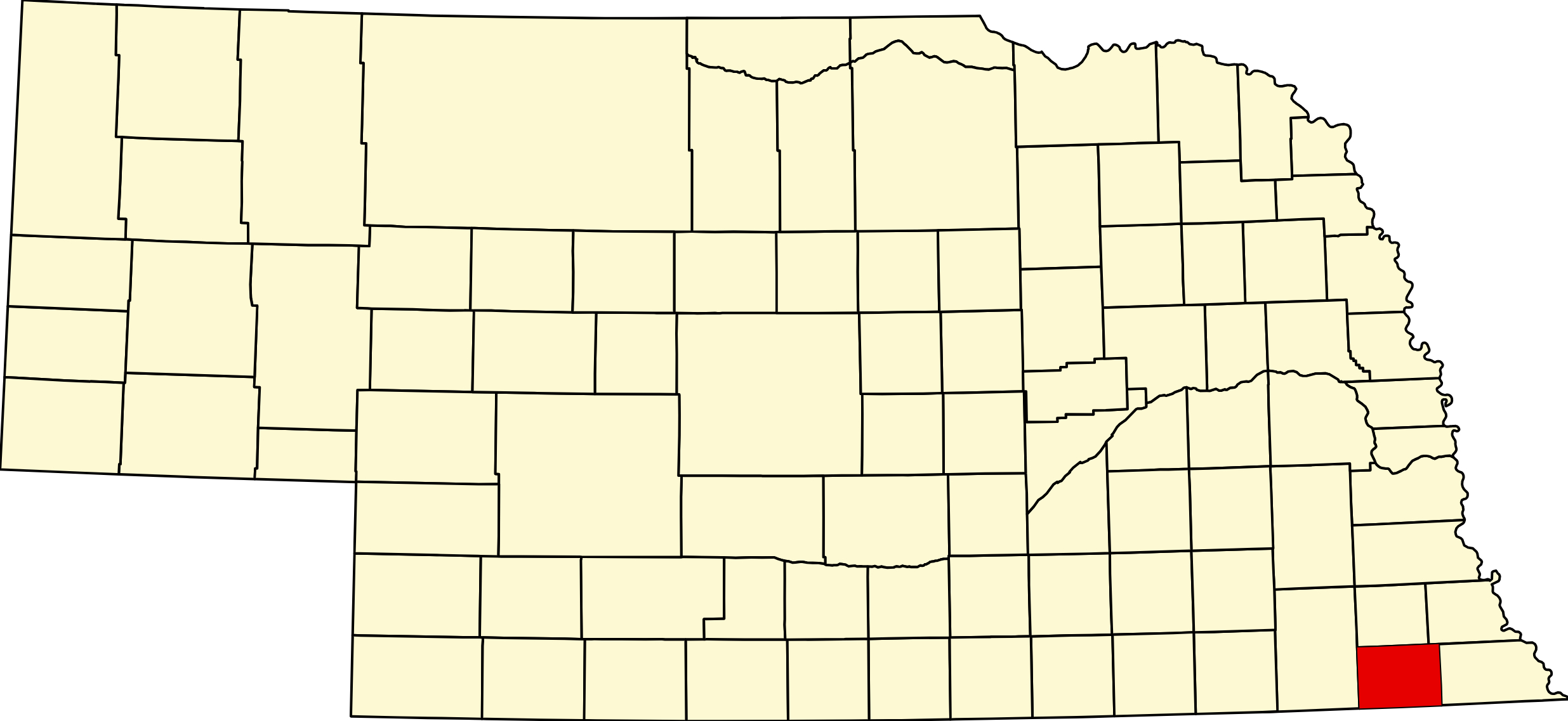
Pawnee County, Nebraska
County seat: Pawnee City · Created: by the territorial legislature on March 3, 1855 (often given as 1854) · Named for: the Pawnee people · License plates: prefix 54 · Population: 2,544 (2020 census; peak 11,770 in 1900) · Area: 431 sq mi of land
About Pawnee County
Pawnee County lies on the Kansas line in southeastern Nebraska, a county of rolling farm and ranch land drained by the forks of the Nemaha River; about 86 percent of the land is farmed or ranched. It is named for the Pawnee, whose four bands moved to Oklahoma in 1874–75. Pawnee City was chosen as county seat in 1856 and laid out in 1857. Settlers founded Cincinnati on the South Fork in 1857, a Pennsylvania and New York colony took up Table Rock that year, and the Swiss Steinauer brothers settled near Steinauer in 1856.
The Atchison & Nebraska Railroad reached Table Rock in 1871, the Burlington's line to Wymore founded Burchard and reached Pawnee City in 1881, and a Rock Island line built in 1886–87 created Du Bois, Steinauer and Lewiston. The county counted 11,770 people in 1900. Silent-film star Harold Lloyd was born at Burchard in 1893. No U.S. highway enters the county; state highways connect its six towns.
Towns of Pawnee County
Cities and villages
Pawnee City
The Pawnee County seat, a city of 865 chosen in 1856 and rebuilt in brick after an 1881 fire. A National Register downtown around the 1911 courthouse, a 22-building historical museum, a sand-green golf course and the county fair in July.
Table Rock
Village of 233 known as "Museum Town," with nine museums around a National Register public square, including the 1893 opera house. Named for a flat-topped rock on the high ground nearby.
Steinauer
Village of 59 settled in 1856 by three Swiss brothers (locals say "Steener"). The 1927 Romanesque St. Anthony Church and the National Register Steinauer Opera House stand on Main Street.
Du Bois
Village of 122 near the Kansas line, platted on the railroad in 1886 and named for engineer Charles J. DuBois. The 1921 Czech hall north of town is on the National Register; Iron Horse Trail Lake is nearby.
Burchard
Village of 76 laid out on the Burlington in 1881 and birthplace of silent-film star Harold Lloyd, whose house is on the National Register. Burchard Lake has prairie-chicken viewing blinds each spring.
Lewiston
Village of 55 in the county's northwest corner, platted on the Rock Island in 1886. Home of Lewiston Consolidated Schools, a PK–12 campus on Tiger Avenue.
Former towns and post office communities
Cincinnati
Early town on the South Fork of the Nemaha, platted as early as 1857 near the county's first settlements, with its first water-powered grist mill. Passed by the railroad, it gave way to Du Bois; its cemetery remains.
Mission Creek
Settlement on Mission Creek in the county's southwest corner, where a Presbyterian school for Otoe children opened in 1857. Its United Presbyterian church lasted from 1873 to 1962; the cemetery remains.
Travel Corridors
NE 50 — north–south from the Kansas line through Du Bois and Pawnee City, past Table Rock and Steinauer, to Tecumseh and Omaha. NE 50 Corridor →
State highways — NE 4 across the north of the county through Table Rock, past Lewiston; NE 8 east–west through Pawnee City and Du Bois toward Falls City; NE 65 from the Kansas line through Pawnee City to Table Rock; NE 99 from the Kansas line through Burchard to NE 4; and NE 105 north from NE 4 east of Table Rock. The nearest U.S. highway is US 136 at Tecumseh.
Cameras: View Pawnee County cameras → · Road conditions: Nebraska 511
Things to See
In Pawnee City: the historic downtown and 1911 courthouse, the Carnegie library and the 22-building Pawnee City Historical Society museum. In Table Rock: the Museums of Table Rock around the public square, including the 1893 opera house. In Steinauer: St. Anthony Church and the opera house. In Burchard: the Harold Lloyd Birthplace. North of Du Bois: the 1921 Czech Hall.
Outdoors
Burchard Lake in the Burchard WMA has fishing, camping and prairie-chicken viewing blinds from February to April. The Nemaha NRD's Iron Horse Trail Lake near Du Bois has camping, a boat ramp and swimming. Hunters can use the Pawnee Prairie (1,140 acres), Table Rock, Bowwood, Taylor's Branch, Mayberry, Prairie Knoll and Lores Branch wildlife management areas. Pawnee City's Fairview Golf Course still has sand greens.
Pawnee County Business Directory
Businesses within 20 miles of: Pawnee City · Table Rock · Du Bois · Burchard · Lewiston · All listings →
Adjacent Counties
Johnson County (north) · Nemaha County (northeast) · Richardson County (east) · Nemaha County, Kansas (southeast) · Marshall County, Kansas (southwest) · Gage County (west)
Events
2026 dates: the Pawnee County Fair in Pawnee City (July 13–18), with the 4-H fair, a tractor pull and a rodeo; and Pawnee City's Fall Festival and Kids Carnival (October 10). Prairie-chicken viewing at Burchard Lake runs from February to April.
Events in Pawnee County
- Pawnee County Fair (Pawnee City)
Pawnee County Fair, a county fair in Pawnee City, Nebraska.
Know of another event in the county? Tell us about it.
Pawnee County at a Glance
Pawnee County, Nebraska — on the Kansas line in the southeast. County seat Pawnee City; five villages: Table Rock, Du Bois, Burchard, Steinauer and Lewiston.
Getting there: NE 50 from Tecumseh or Kansas, NE 8 from Falls City, and NE 4 from Beatrice or Humboldt.
For visitors: Pawnee City's historic downtown and museum, Table Rock's museums, the Harold Lloyd Birthplace in Burchard, St. Anthony Church in Steinauer, Burchard Lake and Iron Horse Trail Lake. Hospital: Pawnee County Memorial Hospital in Pawnee City.
Vehicles registered in Pawnee County carry license plate number 54. See what every Nebraska county number means.
Pawnee County Businesses & Places
125 listings in Pawnee County.
Click a category to see the businesses.
Eat & Drink (4)
- Old Guys Brew — Cafe / Coffee Shop, Nebraska
- RoundUp Bar & Grill — Restaurant, Nebraska
- Table Rock Senior Diner — Restaurant, Nebraska
- The Little Brown Jug — Bar & Grill, Nebraska
Outdoors & Recreation (11)
- Bowwood WMA — Public Hunting Areas & WMAs, Nebraska
- Burchard WMA (Burchard Lake) — Public Hunting Areas & WMAs, Burchard
- Fairview Golf Course — Golf Course, Nebraska
- Iron Horse Trail Lake (Nemaha NRD) — Campgrounds & RV Parks, Du Bois
- Lores Branch WMA — Public Hunting Areas & WMAs, Du Bois
- Mayberry WMA — Public Hunting Areas & WMAs, Burchard
- Pawnderosa Campground — Campgrounds & RV Parks, Nebraska
- Pawnee Prairie WMA — Public Hunting Areas & WMAs, Burchard
- Prairie Knoll WMA — Public Hunting Areas & WMAs, Du Bois
- Table Rock WMA — Public Hunting Areas & WMAs, Nebraska
- Taylor's Branch WMA — Public Hunting Areas & WMAs, Nebraska
Places to Visit (4)
- Harold Lloyd Birthplace — Museum, Burchard
- Pawnee City Historical Society Museum — History & Heritage Museums, Nebraska
- Steinauer Community Historical Society — History & Heritage Museums, Nebraska
- The Museums of Table Rock — Specialty Museums, Nebraska
Events & Venues (3)
- Czech Hall (Řád Jan Kollár čis. 101 ZČBJ) — Event Venue / Banquet Hall, Du Bois
- Pawnee County Fair — County Fair, Nebraska
- Pawnee County Fairgrounds — Fairground, Nebraska
Health & Emergency (3)
- Health First Pharmacy — Pharmacy, Nebraska
- Pawnee County Memorial Hospital — Hospital, Nebraska
- Pawnee County Rural Health Clinic — Medical Clinic, Nebraska
Shopping & Gifts (3)
- Creative Thoughts — Gift shop, Nebraska
- Glenn's True Value — Hardware Store, Nebraska
- Pawnee City Thriftway — Grocery, Nebraska
Community & Faith (33)
- Beranek Cemetery — DuBois — Cemeteries, Nebraska
- Bohemian Cemetery — Table Rock — Cemeteries, Nebraska
- Burchard Cemetery — Burchard — Cemeteries, Burchard
- Cincinnati Cemetery — Cemeteries, Cincinnati
- Clear Creek Cemetery — Table Rock — Cemeteries, Nebraska
- DuBois Cemetery — Cemeteries, Du Bois
- DuBois UMC — Methodist Church, Du Bois
- Evergreen Cemetery — Pawnee City — Cemeteries, Nebraska
- Johnson Creek Cemetery — Pawnee City — Cemeteries, Nebraska
- Keiser Cemetery — Pawnee City — Cemeteries, Nebraska
- Lewiston Cemetery — Cemeteries, Lewiston
- Mission Creek Cemetery — Cemeteries, Mission Creek
- Mount Pleasant Cemetery — Burchard — Cemeteries, Burchard
- Pawnee City Cemetery — Pawnee City — Cemeteries, Nebraska
- Pawnee City First UMC — Methodist Church, Nebraska
- Pawnee City, United Presbyterian Church — Presbyterian Church, Nebraska
- Pleasant Valley Cemetery — DuBois — Cemeteries, Nebraska
- Rinne Cemetery — Burchard — Cemeteries, Burchard
- Sacred Heart Burchard — Catholic Church, Burchard
- Sacred Heart Cemetery — Burchard — Cemeteries, Burchard
- Saint Anthonys Cemetery — Steinauer — Cemeteries, Nebraska
- Saint Johns Cemetery — Table Rock — Cemeteries, Nebraska
- Saint Peters Lutheran Church Cemetery — Steinauer — Cemeteries, Nebraska
- Salem UCC — Steinauer — Congregational Church, Nebraska
- Salems Cemetery — Steinauer — Cemeteries, Nebraska
- Southfork Township Cemetery — Pawnee City — Cemeteries, Nebraska
- St. Anthony Steinauer — Catholic Church, Nebraska
- Table Rock Cemetery — Table Rock — Cemeteries, Nebraska
- Table Rock UMC — Methodist Church, Nebraska
- Tanner Cemetery — Pawnee City — Cemeteries, Nebraska
- United Brethren Cemetery — Pawnee City — Cemeteries, Nebraska
- West Branch Cemetery — DuBois — Cemeteries, Nebraska
- Zion Lutheran Church — Lutheran Church, Nebraska
Government & Resources (28)
- Burchard Village Office — City Hall, Burchard
- Du Bois Fire Department — Fire Station, Du Bois
- Du Bois Post Office — Post Office, Du Bois
- Du Bois Village Office — City Hall, Du Bois
- Lewiston Village Office — City Hall, Lewiston
- Pawnee City Chamber of Commerce — Chamber of Commerce, Nebraska
- Pawnee City City Hall — City Hall, Nebraska
- Pawnee City Housing Authority — Housing Authority, Nebraska
- Pawnee City Post Office — Post Office, Nebraska
- Pawnee City Public Library — Libraries, Nebraska
- Pawnee City USDA Service Center — USDA Service Center (FSA/NRCS), Nebraska
- Pawnee County Assessor — County Assessor, Nebraska
- Pawnee County Attorney's Office — County Attorney, Nebraska
- Pawnee County Clerk — County Clerk, Nebraska
- Pawnee County Court — County Court, Nebraska
- Pawnee County Courthouse — Court House, Nebraska
- Pawnee County Driver License Office — County Driver License, Nebraska
- Pawnee County Emergency Management — Emergency Management, Nebraska
- Pawnee County Sheriff — County Sheriff, Nebraska
- Pawnee County Treasurer — County Treasurer, Nebraska
- Pawnee County Veterans Service Office — Veterans Office, Nebraska
- Pawnee County Weed Superintendent — County Weed Control, Nebraska
- PC Assisted Living — Assisted Living, Nebraska
- Steinauer Village Office — City Hall, Nebraska
- Table Rock Fire Department — Fire Station, Nebraska
- Table Rock Post Office — Post Office, Nebraska
- Table Rock Public Library — Libraries, Nebraska
- Table Rock Senior Center — Senior Citizen Center, Nebraska
Education (7)
- Lewiston Consolidated Schools — School District (K-12 / General), Lewiston
- Lewiston Elementary School — Elementary & Middle School, Lewiston
- Lewiston High School — High School, Lewiston
- Pawnee City Elementary School — Elementary & Middle School, Nebraska
- Pawnee City Public Schools — School District (K-12 / General), Nebraska
- Pawnee City Secondary School — Elementary & Middle School, Nebraska
- Pawnee County Extension — County Extension Office, Nebraska
Utilities (7)
- Pawnee County RWD #1 — Water Utility / District, Nebraska
- Pawnee County RWD #2 — Water Utility / District, Nebraska
- Village of Burchard — Water Utility / District, Burchard
- Village of Dubois — Water Utility / District, Du Bois
- Village of Lewiston — Water Utility / District, Lewiston
- Village of Steinauer — Water Utility / District, Nebraska
- Village of Table Rock — Water Utility / District, Nebraska
Professional Services (5)
- Community Insurance Group — Insurance, Nebraska
- State Bank of Table Rock — Banking, Nebraska
- Stehlik Law Office — Attorney, Nebraska
- Union Bank - Pawnee City — Banking, Nebraska
- Your Insurance Coach — Insurance, Nebraska
Automotive (5)
- Friedly Oil — Auto Repair, Du Bois
- H&H Auto Parts — Auto Parts, Nebraska
- Kyles Service Center — Auto Repair, Nebraska
- Sitzman Repair & Auto — Auto Repair, Nebraska
- Smith Auto — Auto Repair, Nebraska
Agriculture & Farm (4)
- Big Blue Ranch & Lodge — Boarding Stable, Burchard
- Den's Country Meats, Inc. — Custom Meat Locker / Processing, Nebraska
- Johnson Seed — Seed Dealer, Nebraska
- Southeast NE Feeds — Animal Feed Store, Du Bois
Personal Services (2)
- Elaine's Hair Studio — Beauty Salon, Nebraska
- Wherry Mortuary — Funeral Home, Nebraska
Media (2)
- K33AC-D Channel 12 - Pawnee City — TV Translator, Nebraska
- Pawnee Republican — News Paper, Nebraska
Transportation (2)
- Pawnee City Municipal Airport — Municipal / General Aviation Airport, Nebraska
- Pawnee County Handi Bus — Public Transportation, Nebraska
Manufacturing & Industrial (1)
- Alphia — Food & Beverage Manufacturing, Nebraska
Land & Property Services (1)
- Kramers Kutting LLC — Land Clearing & Brush Removal, Nebraska