Saline County, Nebraska
County seat: Wilber · Largest city: Crete · Created: 1855; organized February 18, 1867 · Named for: salt springs the first settlers believed were here · License plates: prefix 22 · Population: 14,292 (2020 census); peak 20,097 in 1890 · Area: 576 sq mi
About Saline County
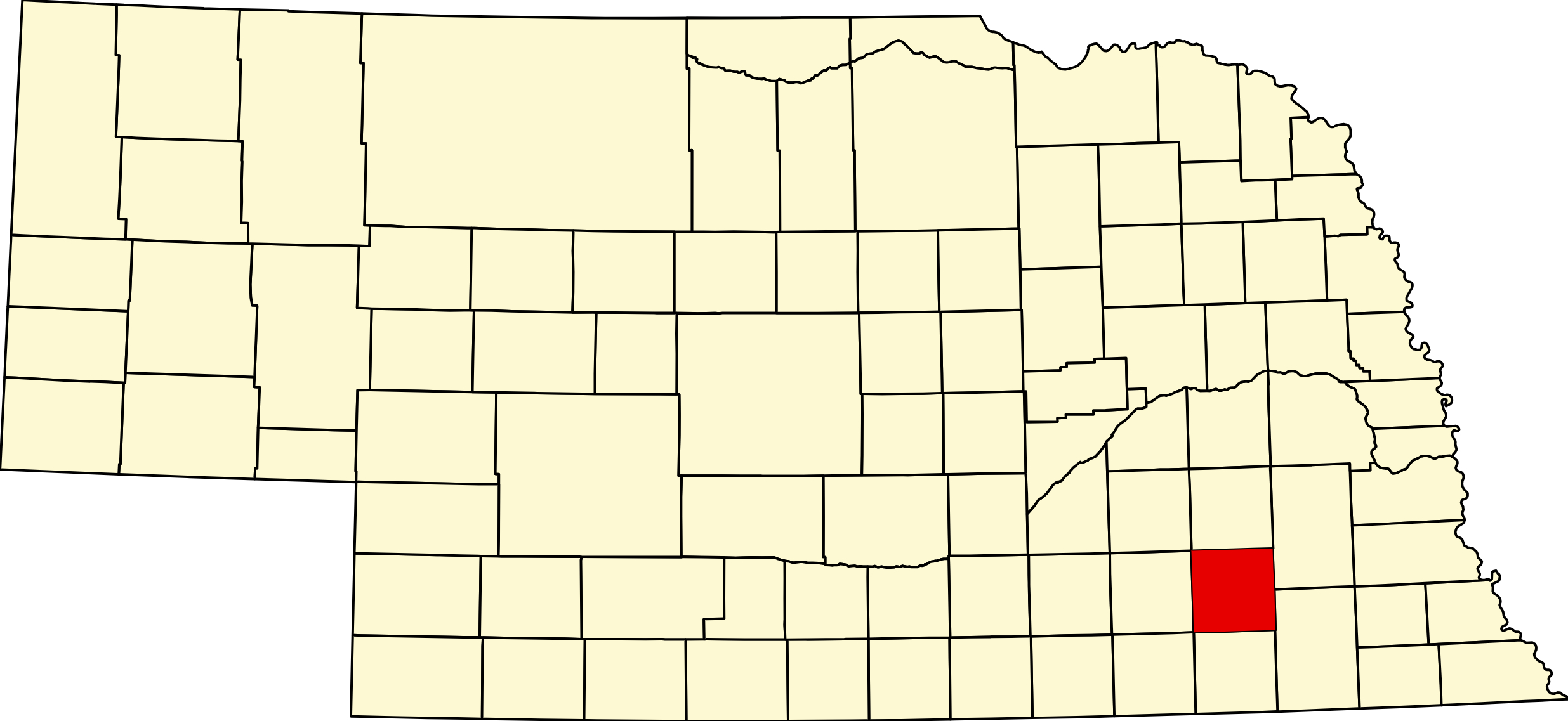
Saline County lies in southeastern Nebraska, southwest of Lincoln, crossed from north to south by the Big Blue River. The name was a mistake that stuck: early settlers believed there were great salt springs here, but none were ever found. Czech immigrants began arriving in 1865, and by 1900 they made up most of the population of Wilber, which was named Czech Capital of Nebraska in 1963 and Czech Capital of the USA in 1987.
The county seat moved twice. Swan City, west of present DeWitt, was the first seat when the county was organized in 1867. Pleasant Hill won an election on June 3, 1871, and took the records that July. After three votes in 1877, Wilber won by 230 votes, and on January 28, 1878, about 300 people with 160 wagons drove to Pleasant Hill and carried the records away. The present courthouse in Wilber was begun in 1928 and finished in 1929.
The Burlington & Missouri River Railroad built west from Lincoln in 1870–71, naming its stations in alphabetical order: Berks, Crete, Dorchester, Exeter, Fairmont. Friend followed in 1873, a branch south along the Big Blue created Wilber and DeWitt in 1872–73, and a line west from DeWitt founded Swanton and Tobias in 1883–84. Doane University was founded at Crete in 1872, the Vise-Grip was invented at DeWitt in 1924, and Crete's meatpacking plant is now the largest employer. On February 18, 1969, a derailment at Crete released anhydrous ammonia that killed six residents; three men riding the train also died and 53 people were hurt.
Towns of Saline County
Cities and villages
Crete
Saline County's largest city, 7,099 people on the Big Blue River, formed in 1871 and home of Doane University since 1872. A National Register downtown, Tuxedo Park and the county fair, and Crete Area Medical Center.
Wilber
The Saline County seat, a city of 1,937 on the Big Blue River, and the Czech Capital of the USA. The Czech Festival on the first full weekend of August, the Czech Museum, the 1895 Hotel Wilber and the courthouse.
Friend
City of 954 on US 6 in the county's northwest, named for homesteader Charles E. Friend and laid out on the Burlington in 1873. Warren's Opera House, a rural emergency hospital and the birthplace of the National Greyhound Association.
Dorchester
Village of 596 on the Burlington main line where NE 33 leaves US 6 and NE 15, platted in 1870 as DeWitt and renamed. The Saline County Historical Society Museum, with 15 buildings, and Dorchester Public Schools.
Western
Village of 224 in the county's southwest, just off NE 15, laid out in 1872 and probably named for homesteader Wesley West. Home of Saline County Area Transit; the Old Settlers' Picnic dates from 1897.
Tobias
Village of 114 on NE 74 near the Fillmore County line, platted on the Burlington in 1884 and named for Tobias Castor after "Castor" was refused. Rebuilt in brick after an 1891 fire; Willard Meyer Recreation Area is nearby.
Swanton
Village of 82 in southern Saline County, laid out in 1883 on the railroad between DeWitt and Tobias and named for Swan Creek. Home of First Tri-County Bank and of 1936 Olympic champion Willard Schmidt.
DeWitt
Village of 530 on NE 103 near the Big Blue, founded on the Burlington in 1872 and settled by the people of Swan City. The Vise-Grip locking pliers were invented and made here from 1924 to 2008.
Former towns and post office communities
Swan City
Saline County's first town and first county seat, at the forks of Swan and Turkey creeks, abandoned after the railroad passed it by in 1871. A historical marker on NE 103 tells its story.
Pleasant Hill
Mill town between Turkey and Spring creeks that was the Saline County seat from 1871 until Wilber took the records by wagon train in 1878. Its cemetery and a 2009 historical marker remain.
Berks
Burlington station on the Lancaster–Saline county line about 3 miles northeast of Crete, one of the railroad's alphabetical towns west of Lincoln.
Shestak
Czech farm community on NE 103 between Crete and Wilber, named for Bohemian settler Václav Šesták, with a post office in 1893–94.
Travel Corridors
US 6 — east–west across the north through Friend and past Dorchester, toward Milford and Lincoln. US 6 Corridor →
NE 15 — north–south through the west of the county, past Western and Dorchester, from Fairbury to Seward. NE 15 Corridor →
State highways — NE 33 from Dorchester through Crete toward Lincoln; NE 103 north–south through DeWitt, Wilber and Crete; NE 41 east–west through Wilber; and NE 74 through Tobias.
Cameras: View Saline County cameras → · Road conditions: Nebraska 511
Things to See
In Wilber, the Wilber Czech Museum, the 1895 Hotel Wilber, the Sokol Pavilion and the courthouse; in Crete, the Doane University campus and Boswell Observatory, the downtown historic district and the Crete Heritage Society; the Saline County Historical Society Museum at Dorchester; Warren's Opera House in Friend; Czech lodge halls near Dorchester and Western; and the Swan City and Pleasant Hill historical markers at the old county seats.
Outdoors
The Lower Big Blue NRD runs the public lakes: Walnut Creek Recreation Area north of Crete and the Willard L. Meyer Recreation Area (Swan Lake) near Tobias, with camping. Tuxedo Park in Crete and Legion Memorial Park in Wilber have RV sites, and hunters can use Swan Creek WMA. There is no state park or state recreation area in the county; Bluestem State Recreation Area is just east in Lancaster County.
Saline County Business Directory
Businesses within 20 miles of: Crete · Wilber · Friend · DeWitt · Dorchester · All listings →
Adjacent Counties
Seward County (north) · Lancaster County (east) · Gage County (southeast) · Jefferson County (south) · Fillmore County (west); York County (northwest) and Thayer County (southwest) touch only at the corners
Events
2026 dates: the Saline County Fair at Tuxedo Park in Crete (July 14–19); the 65th Wilber Czech Festival (July 31–August 2); DeWitt Days and Fourth of July celebrations in Friend and DeWitt; the Western Old Settlers' Picnic; and Crete's Great Pumpkin Festival on the first weekend of October.
Events in Saline County
- Crete’s Great Pumpkin Festival (Crete)
Crete's Great Pumpkin Festival is held in Crete, Nebraska, on the first weekend of October. - DeWitt Days (De Witt)
DeWitt Days is held in DeWitt, Nebraska, on the Fourth of July weekend. - Nebraska Czech Festival (Wilber)
- Saline County Fair (Crete)
Saline County Fair, a county fair in Wilber, Nebraska.
Know of another event in the county? Tell us about it.
Saline County Road Map
Download the printable county road map (PDF, Nebraska Dept. of Transportation)
Saline County at a Glance
Saline County, Nebraska — southwest of Lincoln along the Big Blue River. County seat Wilber, the Czech Capital of the USA; the largest city is Crete, home of Doane University.
Getting there: US 6 across the north, NE 33 and NE 103 from Lincoln and I-80, and NE 15 from Seward or Fairbury.
For visitors: the Wilber Czech Festival and Czech Museum, Doane University and historic Crete, the county museum at Dorchester, Warren's Opera House in Friend, and camping at Tuxedo Park, Legion Memorial Park and the NRD lakes. Hospitals: Crete Area Medical Center; Friend Community Healthcare System.
Vehicles registered in Saline County carry license plate number 22. See what every Nebraska county number means.
Saline County Businesses & Places
243 listings in Saline County.
Click a category to see the businesses.
Eat & Drink (10)
- 9th Street Grill — Bar & Grill, Crete
- Burger King - Crete (428 E 13th St) — Burger King, Crete
- Casey's — Pizza Restaurant, Nebraska
- Domino's Pizza - Crete (542 E 16th St) — Domino's Pizza, Crete
- Guanajuato Mexican Restaurant — Mexican Restaurant, Crete
- Jimmy John's - Crete (1615 Hawthorne Ave) — Jimmy John's, Crete
- Pizza Hut — Pizza Restaurant, Crete
- Runza Crete — Runza, Crete
- Subway – 511 S. Main, Wilber — Subway, Nebraska
- Subway – 925 Main, Crete — Subway, Crete
Stay (1)
- Hotel Wilber — Hotel, Nebraska
Outdoors & Recreation (8)
- College Heights Country Club — Country Club, Crete
- Divoky Acres WMA — Public Hunting Areas & WMAs, Nebraska
- Friend Country Club — Country Club, Friend
- Legion Memorial Park — Campgrounds & RV Parks, Nebraska
- Swan Creek WMA — Public Hunting Areas & WMAs, Nebraska
- Tuxedo Park — Campgrounds & RV Parks, Crete
- Western Village Park — Campgrounds & RV Parks, Nebraska
- Willard L. Meyer Recreation Area — Campgrounds & RV Parks, Nebraska
Places to Visit (15)
- A Touch of the Past Museum — Specialty Museums, De Witt
- Boswell Observatory — Specialty Museums, Crete
- Crete Heritage Society and Benne Memorial Museum — History & Heritage Museums, Crete
- Czech Heritage Room - Dvoracek Memorial Library — History & Heritage Museums, Nebraska
- DeWitt Historical Society and Museum — History & Heritage Museums, De Witt
- Friend Historical Society — History & Heritage Museums, Friend
- Pleasant Hill Historical Marker — Historic Marker, Nebraska
- Rad Saline Center Z.C.B.J. Hall — Attraction, Nebraska
- Saline County Historical Society and Museum — History & Heritage Museums, Dorchester
- Sokol Pavilion — Attraction, Nebraska
- Swan City Historical Marker — Historic Marker, Nebraska
- Tobias Community Historical Society — History & Heritage Museums, Nebraska
- Walnut Creek Recreation Area — Attraction, Crete
- Wilber Czech Museum — Specialty Museums, Nebraska
- Z.C.B.J. Rad Tabor No. 74 Hall — Attraction, Dorchester
Events & Venues (6)
- Crete's Great Pumpkin Festival — Festivals & Celebrations, Crete
- DeWitt Days — Festivals & Celebrations, De Witt
- Nebraska Czech Festival — Festivals & Celebrations, Nebraska
- Saline County Fair — County Fair, Crete
- Saline County Fairgrounds — Fairground, Crete
- Warren's Opera House — Event Venue / Banquet Hall, Friend
Health & Emergency (9)
- Animal Clinic — Mixed / General Practice, Friend
- Crete Area Medical Center — Hospital, Crete
- Crist Family Chiropractic — Chiropractor, Friend
- Friend Community Healthcare System — Hospital, Friend
- Friend Medical Clinic — Medical Clinic, Friend
- Johnson's Pharmacy — Pharmacy, Friend
- Kubicek Richard DDS PC — Dentist & Dental Office, Friend
- Warren Memorial Hospital d/b/a Zimmer Medical Clinic — Medical Clinic, Friend
- Wilber Medical Clinic (Crete Area Medical Center) — Medical Clinic, Nebraska
Shopping & Gifts (2)
- Blue Blossom Floral — Florist, Friend
- Dollar General - Friend — Dollar Store, Friend
Community & Faith (55)
- Amateur Radio Repeaters - Saline County (via RepeaterBook.com) — Amateur Radio Repeater, Nebraska
- Andrew Cemetery — Friend — Cemeteries, Friend
- Applegate Cemetery — Wilber — Cemeteries, Nebraska
- Atlanta Cemetery — Wilber — Cemeteries, Nebraska
- Bethlehem Lutheran Church — Lutheran Church, Crete
- Blue Valley Cemetery — Crete — Cemeteries, Crete
- Bohemian National Cemetery — Wilber — Cemeteries, Nebraska
- Crete Grace UMC — Methodist Church, Crete
- Dorchester Cemetery — Dorchester — Cemeteries, Dorchester
- Dorchester UMC — Methodist Church, Dorchester
- First Congregational UCC — Crete — Congregational Church, Crete
- First Lutheran Church — Lutheran Church, Nebraska
- Friend UMC — Methodist Church, Friend
- Friendville Cemetery — Friend — Cemeteries, Friend
- Gilbert-Hulse Cemetery — Friend — Cemeteries, Friend
- Johnson Creek Cemetery — Friend — Cemeteries, Friend
- Kasak Cemetery — Friend — Cemeteries, Friend
- Monroe Cemetery — Wilber — Cemeteries, Nebraska
- North Fork Cemetery — Wilber — Cemeteries, Nebraska
- Oak Grove Cemetery — De Witt — Cemeteries, De Witt
- Old Zion Cemetery — Tobias — Cemeteries, Nebraska
- Plainview Cemetery — Western — Cemeteries, Nebraska
- Pleasant Hill Cemetery — Dorchester — Cemeteries, Nebraska
- Pleasant View Cemetery — Crete — Cemeteries, Crete
- Plummer Branch Cemetery — Swanton — Cemeteries, Nebraska
- Plymouth Congregational UCC — Crete — Congregational Church, Crete
- Radiant Springs Church — Pentecostal, Crete
- Riverside Cemetery — Crete — Cemeteries, Crete
- Sacred Heart Catholic Church Crete — Catholic Church, Crete
- Sacred Heart Cemetery — Crete — Cemeteries, Crete
- Saint John's UCC — Western — Congregational Church, Nebraska
- Saint Josephs Cemetery — Friend — Cemeteries, Friend
- Schmidt Cemetery — Wilber — Cemeteries, Nebraska
- South Fork Cemetery — Swanton — Cemeteries, Nebraska
- St. Augustine's Episcopal Church — Episcopal Church, De Witt
- St. John Lutheran Church — Lutheran Church, Crete
- St. Joseph Catholic Church Tobias — Catholic Church, Nebraska
- St. Joseph Friend — Catholic Church, Friend
- St. Paul Lutheran Church — Lutheran Church, De Witt
- St. Wenceslaus Catholic Church Wilber — Catholic Church, Nebraska
- Summit Cemetery — Swanton — Cemeteries, Nebraska
- Sunny Side Cemetery — Wilber — Cemeteries, Nebraska
- Swan Valley Cemetery — Swanton — Cemeteries, Nebraska
- Swanton UMC — Methodist Church, Nebraska
- Tobias Cemetery — Tobias — Cemeteries, Nebraska
- Trinity Lutheran Church — Lutheran Church, De Witt
- Trinity Memorial Episcopal Church — Episcopal Church, Crete
- Turkey Creek Cemetery — Friend — Cemeteries, Friend
- Tvrz Cemetery — Friend — Cemeteries, Friend
- Union Cemetery — Western — Cemeteries, Nebraska
- Waymire Cemetery — Swanton — Cemeteries, Nebraska
- Wilber UMC — Methodist Church, Nebraska
- Zastrow Cemetery — Friend — Cemeteries, Friend
- Zion Lutheran Cemetery — Tobias — Cemeteries, Nebraska
- Zion Lutheran Church — Lutheran Church, Nebraska
Government & Resources (53)
- Bob and Wauneta Burkley Library - DeWitt — Libraries, De Witt
- City of Crete Housing Authority — Housing Authority, Crete
- Crete Chamber of Commerce — Chamber of Commerce, Crete
- Crete City Hall — City Hall, Crete
- Crete Fire Department — Fire Station, Crete
- Crete Police Department — Police Station, Crete
- Crete Post Office — Post Office, Crete
- Crete Public Library — Libraries, Crete
- DeWitt Fire Department — Fire Station, De Witt
- DeWitt Post Office — Post Office, De Witt
- DeWitt Senior Center — Senior Citizen Center, De Witt
- DeWitt Village Office — City Hall, De Witt
- Dorchester Chamber of Commerce — Chamber of Commerce, Dorchester
- Dorchester Fire Department — Fire Station, Dorchester
- Dorchester Post Office — Post Office, Dorchester
- Dorchester Public Library — Libraries, Dorchester
- Dvoracek Memorial Library - Wilber — Libraries, Nebraska
- Friend Chamber of Commerce — Chamber of Commerce, Friend
- Friend City Hall — City Hall, Friend
- Friend Fire Department — Fire Station, Friend
- Friend Housing Authority — Housing Authority, Friend
- Friend Police Department — Police Station, Friend
- Friend Post Office — Post Office, Friend
- Gilbert Public Library - Friend — Libraries, Friend
- Public Health Solutions District Health Department — County/District Health Department, Crete
- Saline County Aging Services — Senior Citizen Center, Nebraska
- Saline County Assessor — County Assessor, Nebraska
- Saline County Attorney's Office — County Attorney, Nebraska
- Saline County Clerk — County Clerk, Nebraska
- Saline County Court — County Court, Nebraska
- Saline County Courthouse — Court House, Nebraska
- Saline County Driver License Office — County Driver License, Nebraska
- Saline County Emergency Management — Emergency Management, Nebraska
- Saline County Sheriff — County Sheriff, Nebraska
- Saline County Treasurer — County Treasurer, Nebraska
- Saline County Veterans Service Office — Veterans Office, Nebraska
- Saline County Weed Superintendent — County Weed Control, Nebraska
- Struckman-Baatz Public Library - Western — Libraries, Nebraska
- Swanton Village Office — City Hall, Nebraska
- Tobias Fire & Rescue — Fire Station, Nebraska
- Tobias Post Office — Post Office, Nebraska
- Tobias Village Office — City Hall, Nebraska
- United States Postal Service - Friend — Post Office, Friend
- Western Fire Department — Fire Station, Nebraska
- Western Post Office — Post Office, Nebraska
- Western Village Office — City Hall, Nebraska
- Wilber Area Chamber of Commerce — Chamber of Commerce, Nebraska
- Wilber City Hall — City Hall, Nebraska
- Wilber Fire Station — Fire Station, Nebraska
- Wilber Housing Authority — Housing Authority, Nebraska
- Wilber Police Department — Police Station, Nebraska
- Wilber Post Office — Post Office, Nebraska
- Wilber USDA Service Center — USDA Service Center (FSA/NRCS), Nebraska
Education (24)
- Crete Elementary School — Elementary & Middle School, Crete
- Crete High School — High School, Crete
- Crete Intermediate School — Elementary & Middle School, Crete
- Crete Middle School — Elementary & Middle School, Crete
- Crete Preschool — Elementary & Middle School, Crete
- Crete Public Schools — School District (K-12 / General), Crete
- Crete Success Academy — Elementary & Middle School, Crete
- Doane University – Crete Campus — 4-Year College / University, Crete
- Dorchester Elementary School — Elementary & Middle School, Dorchester
- Dorchester High School — High School, Dorchester
- Dorchester Public School — School District (K-12 / General), Dorchester
- Elementary School at Wilber — Elementary & Middle School, Nebraska
- Emf High School — High School, Friend
- Emf Middle School — Elementary & Middle School, Friend
- Exeter-Milligan-Friend Public Schools — School District (K-12 / General), Friend
- Friend Prekindergarten — Elementary & Middle School, Friend
- Saline County Extension — County Extension Office, Nebraska
- St James Elementary School Crete — Faith-Based School, Crete
- Tri County Elementary School — Elementary & Middle School, De Witt
- Tri County Jr-Sr High School — High School, De Witt
- Tri County Public Schools — School District (K-12 / General), De Witt
- Wilber-Clatonia High School — High School, Nebraska
- Wilber-Clatonia Middle School — Elementary & Middle School, Nebraska
- Wilber-Clatonia Public Schools — School District (K-12 / General), Nebraska
Automotive (17)
- Bartel's Body Shop — Auto Body Repair, Friend
- BE Auto Sales — Used Car Dealer, Crete
- Car Quest — Auto Parts, Friend
- Casey's General Store - Crete — Casey's, Crete
- Fenix Auto Sales — Used Car Dealer, Crete
- Kleine Repair — Auto Repair, Nebraska
- MB Auto Plaza — Used Car Dealer, Crete
- Paynes Automotive — Auto Repair, Friend
- Pfingsten Auto Repair — Auto Repair, De Witt
- Qwik 6 — Fuel & Gas Station, Friend
- R & R Truck Sales — Truck Dealership, Nebraska
- Rabbits Auto Sales — Used Car Dealer, Crete
- Sid Dillon Chevrolet Ford Chrysler Dodge Jeep Ram Crete — Franchised New Car Dealer, Crete
- Siedhoff Auto Center — Used Car Dealer, Crete
- Svarc Auto — Used Car Dealer, Crete
- Tyser Auto Sales — Used Car Dealer, Dorchester
- Wilber Body Shop — Auto Body Repair, Nebraska
Utilities (11)
- City of Crete — Water Utility / District, Crete
- City of Friend — Water Utility / District, Friend
- Crete Municipal Utilities — Electric Power Provider, Crete
- DeWitt Municipal Utilities — Electric Power Provider, De Witt
- Dorchester Municipal Utilities — Electric Power Provider, Dorchester
- Village of Dewitt — Water Utility / District, De Witt
- Village of Dorchester — Water Utility / District, Dorchester
- Village of Swanton — Water Utility / District, Nebraska
- Village of Tobias — Water Utility / District, Nebraska
- Village of Western — Water Utility / District, Nebraska
- Wilber Municipal Utilities — Electric Power Provider, Nebraska
Agriculture & Farm (9)
- AKRS Equipment Solutions - Crete — Equipment Dealers, Crete
- Farmers Co-op Elevator — Grain Elevator, Nebraska
- Farmers Cooperative – Dorchester — Farm Coop, Dorchester
- Farmers Cooperative Service Center — Farm Coop, De Witt
- Farmers Union Co-op - Friend — Farm Coop, Friend
- Smithfield Fresh Meats Corp. — Packing House, Crete
- Snyder Performance Horses — Horse Trainer, Crete
- Straight Arrow Cowhorses — Boarding Stable, Crete
- Thunderstruck Farms — Boarding Stable, Nebraska
Professional Services (8)
- Citizens State Bank - Friend — Banking, Friend
- Edward Jones - Preston Meints — Financial Consultant, Friend
- First State Bank — Banking, De Witt
- First Tri-County Bank — Banking, Nebraska
- Jones Group – Wilber — Insurance, Nebraska
- Maximum Storage — Self-Storage Facility, De Witt
- Nebraska Title Company - Crete — Crete
- Zalesky Realty & Auction — Auction Service, Crete
Media (8)
- Crete News — News Paper, Crete
- Doane Owl — News Paper, Crete
- Friend Sentinel — News Paper, Friend
- K-LOVE / Air1 89.9 FM - Wilber — K-LOVE / Air1, Nebraska
- KCPJ-LP 105.7 FM - Crete — Radio Station, Crete
- KDNE 91.9 FM - Crete — Radio Station, Crete
- KGCO-LP 107.9 FM - Crete — Radio Station, Crete
- Wilber Republican — News Paper, Nebraska
Personal Services (3)
- Kids Spot Daycare — Day Care Center, De Witt
- Lauber-Moore Funeral Home — Funeral Home, Friend
- Studio 508 — Beauty Salon, Friend
Transportation (2)
- Crete Municipal Airport — Municipal / General Aviation Airport, Crete
- Saline County Area Transit — Public Transportation, Nebraska
Trades & Construction (2)
- Drake Refrigeration & Appliance — HVAC Contractor, Friend
- Wil-Dew Plumbing and Heating — Plumbing & Heating, De Witt