
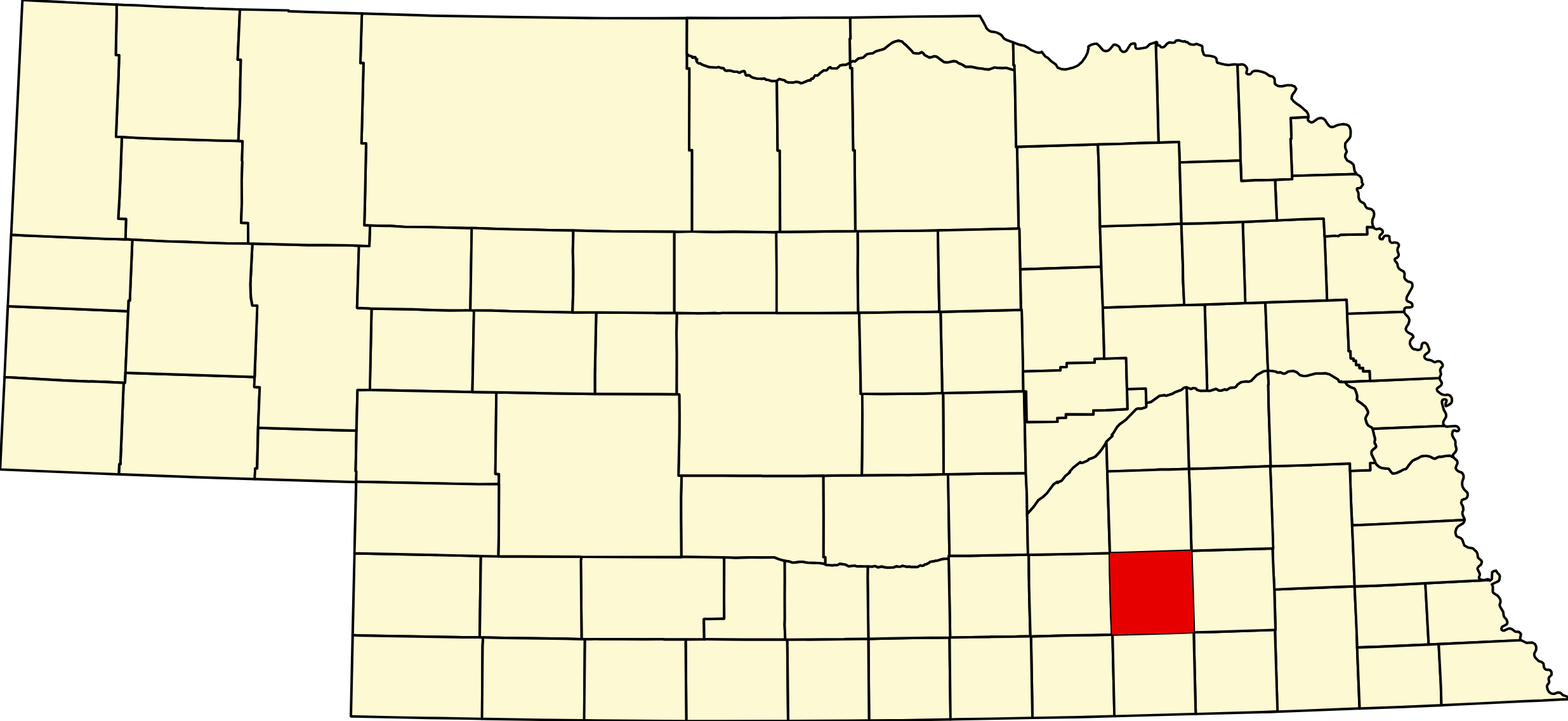
Towns in Fillmore County Nebraska
Fillmore County, Nebraska
County Seat: Geneva
Founded: 1856
Named For: Millard Fillmore, 13th President of the United States
License Plate Prefix: 34
Population: 5,462 (2020 census)
Area: 576 sq mi
History
Fillmore County was established in 1856 and named after President Millard Fillmore. Early settlers were drawn to the area’s fertile prairie and access to water sources. Geneva, the county seat, developed as a center for trade and agriculture. The county’s history includes pioneer homesteads, railroad expansion, and a strong tradition of civic engagement and rural community life.
Geography
Location: South-central Nebraska
Landscape: Rolling prairie, farmland, and small creeks
Major Highways: U.S. 81, Nebraska Highways 41, 74
Adjacent Counties: York (N), Seward (NE), Saline (E), Jefferson (S), Thayer (SW), Nuckolls (W), Clay (NW)
Culture & Landmarks
- Fillmore County Courthouse (Geneva) – Historic courthouse built in 1892.
- Geneva Public Library – Community hub with local history archives.
- Fairmont Army Airfield – WWII-era airfield with historical significance.
- Fillmore County Museum – Preserves pioneer and agricultural heritage.
Notable Communities
- Geneva – County seat and largest town, known for its civic pride.
- Fairmont – Historic town with ties to military aviation.
- Exeter – Active community with schools and local events.
- Milligan – Czech heritage and cultural celebrations.
- Ohiowa, Strang, Shickley, Grafton – Small towns with deep agricultural roots.
Events & Festivals
- Fillmore County Fair (Geneva) – Livestock shows, exhibits, and entertainment.
- Milligan Czech Festival – Celebrates Czech heritage with music and food.
- Exeter Fun Days – Parade, games, and community gatherings.
Natural Attractions & Recreation
- Geneva City Park – Trails, playgrounds, and community events.
- Fairmont State Wildlife Management Area – Birdwatching and outdoor recreation.
- Local Lakes & Trails – Fishing, walking paths, and quiet retreats.
Living in Fillmore County
Fillmore County offers a peaceful rural lifestyle with strong community ties. Geneva provides essential services and cultural amenities, while surrounding towns preserve agricultural traditions and local pride. With its festivals, landmarks, and natural beauty, Fillmore County is a welcoming place to live and explore.
Fillmore County Road Map
Download the printable county road map (PDF, Nebraska Dept. of Transportation)
Fillmore County at a Glance
Fillmore County, Nebraska — created by the Territorial Legislature on 26 January 1856 and named for Millard Fillmore, thirteenth President, three years after he left office. It was not organized until 15 March 1871, when Acting Governor William H. James issued the proclamation; before that it was governed from Saline County. The first homesteaders, William Bussard and William Whitaker, filed on the West Fork of the Big Blue in June 1866. County seat Geneva. Population peaked at 16,022 in 1890 and stands at 5,551. 166 listings across 8 towns.
The county seat was called Henry first. Fillmore City, laid out in 1870, was the county’s first town and expected to keep the seat; Manleyville made its own bid in 1871, its proprietor putting up a hall and offering it to the county. Both lost. The seat was placed instead on school land at the county’s geographic center, and the raw site was called Henry until 2 July 1872, when the town was properly surveyed and renamed Geneva. The courthouse and jail contract was let that December for $3,075. The courthouse standing now dates from 1894; its clock went into the tower in 1909.
Getting there: US-81 runs north and south and US-6 east and west across the north, with NE-41 and NE-74. This is flat to gently rolling loess plain, almost all of it under cultivation, drained by the West Fork of the Big Blue and Turkey Creek — and it is Rainwater Basin country, pocked with the shallow playa wetlands that pull the spring waterfowl migration down out of the sky. Geneva sits at 1,637 feet. BNSF runs east and west across the top of the county. Central Time.
Then the grasshoppers came. In early July 1874, on top of drought, the Rocky Mountain locust arrived in numbers that obscured the light of the sun. A county relief-bond proposition failed on 16 January 1875, 200 for and 532 against — a county too proud or too broke to borrow against its own ruin. The hoppers came back in 1876 and did little.
The atomic bomb crews were chosen here. Fairmont Army Air Field, begun on 17 September 1942 across 1,980 acres, trained B-24, B-17 and B-29 crews — seven bombardment groups in all — and housed nearly 6,000 men plus a 350-bed hospital, the largest in Nebraska at the time. In September 1944 Lieutenant Colonel Paul Tibbets came to Fairmont and picked the 393rd Bomb Squadron of the 504th Group for the 509th Composite Group. That squadron dropped both atomic bombs on Japan. The field was declared surplus in 1946 and went on the National Register in 2003; a state historical marker stands on County Road H just east of US-81.
Three settlements, three churches. Czech families took the east of the county — Milligan is the center, and its Česko-národní síň, the Milligan Auditorium, is on the National Register — while Swedes settled the southwest around Shickley, where the Stockholm Swedish Lutheran Church and Cemetery is also listed, and Germans settled throughout. The railroad made the towns: the Burlington came through in the autumn of 1871 and platted Exeter, Fairmont and Grafton along it, and later lines produced Shickley, Strang, Ohiowa and Milligan.
For visitors: nineteen National Register listings for a county of 5,500 — among them the 1894 courthouse, Geneva’s Auditorium and its post office, the Fairmont Creamery Company Building, the Ohiowa Public School, the Strang town hall and jail, two 1992-listed river bridges, and a filling station with its house. The Fillmore County Museum is at Fairmont. At Fairmont the ethanol plant runs about 120 million gallons a year on roughly 42 million bushels of corn, and is the largest industrial presence in the county.
Outdoors, be honest about what is here. Fillmore County has no state park and no state recreation area. What it has is Rainwater Basin: eight state wildlife management areas — Bluebill, Marsh Hawk, Morphy Lagoon, Rauscher Lagoon, Redhead, Rolland Lagoon, Sandpiper and Sora — managed as shallow ephemeral playa for waterfowl rather than as fisheries. For birders in March this is some of the best ground in the state.
Born here. Robert B. Wilson (Geneva, 16 May 1937), Nobel laureate in Economic Sciences in 2020 for work on auction theory and the design of new auction formats — the Nobel Foundation itself gives Geneva as his birthplace. Kate Barnard (Geneva, 1875), who became the first woman elected to major statewide office in Oklahoma, Commissioner of Charities and Corrections in that state’s first general election in 1907, and a lifelong child-labour and prison reformer. And Jeff Zeleny (Exeter, 1973), raised on the family farm and now CNN’s Chief National Affairs Correspondent, previously of ABC News and the New York Times.
Vehicles registered in Fillmore County carry license plate number 34. See what every Nebraska county number means.
Fillmore County Businesses & Places
166 listings in Fillmore County.
Click a category to see the businesses.
Eat & Drink (8)
- Bubba's Anytime Strang Cafe — Diner / Family Restaurant, Nebraska
- Casey's — Pizza Restaurant, Exeter
- Charlie's Pub — Bar & Grill, Milligan
- Lazy Horse Brewing & Winery — Brewery & Taproom, Nebraska
- Ron's Tavern — Bar & Grill, Milligan
- Runza Geneva — Runza, Geneva
- Subway – 203 S 13th Street, Geneva — Subway, Geneva
- Sweetwater Bar & Grill — Bar & Grill, Exeter
Outdoors & Recreation (9)
- Bluebill WMA — Public Hunting Areas & WMAs, Nebraska
- Gilbert Park RV — Campgrounds & RV Parks, Exeter
- Lakeshore RV Park — Campgrounds & RV Parks, Geneva
- Marsh Hawk WMA — Public Hunting Areas & WMAs, Nebraska
- Milligan RV Park — Campgrounds & RV Parks, Milligan
- Ohiowa RV Park — Campgrounds & RV Parks, Nebraska
- Redhead WMA — Public Hunting Areas & WMAs, Nebraska
- Sandpiper WMA — Public Hunting Areas & WMAs, Nebraska
- Sora WMA — Public Hunting Areas & WMAs, Nebraska
Places to Visit (3)
- Fillmore County Museum — History & Heritage Museums, Fairmont
- Old Timers’ Museum — Specialty Museums, Exeter
- Strang Museum — Specialty Museums, Nebraska
Events & Venues (2)
- Fillmore County Fair — County Fair, Geneva
- Fillmore County Fairgrounds — Fairground, Geneva
Health & Emergency (4)
- Fillmore County Medical Center, Pc. — Medical Clinic, Geneva
- Milligan Family Medicine — Medical Clinic, Milligan
- Miracle-Ear Hearing Aid Center Geneva — Hearing Aids, Geneva
- Speece Family Chiropractic — Chiropractor, Exeter
Shopping & Gifts (2)
- Greg's Market — Grocery, Exeter
- Milligan House of Meats — Butcher Shop, Milligan
Community & Faith (47)
- Antioch Cemetery — Ohiowa — Cemeteries, Nebraska
- Bohemian Brethren Cemetery — Milligan — Cemeteries, Milligan
- Bohemian National Cemetery — Milligan — Cemeteries, Milligan
- Chelsea Cemetery — Ohiowa — Cemeteries, Nebraska
- Exeter Cemetery — Exeter — Cemeteries, Exeter
- Fairmont Catholic Cemetery — Fairmont — Cemeteries, Fairmont
- Fairmont Cemetery — Fairmont — Cemeteries, Fairmont
- Fairmont Community Church — Methodist Church, Fairmont
- Fairview Cemetery — Fairmont — Cemeteries, Fairmont
- First Congregational UCC — Exeter — Congregational Church, Exeter
- First Congregational UCC — Geneva — Congregational Church, Geneva
- Franklin Cemetery — Ohiowa — Cemeteries, Nebraska
- Geneva Cemetery — Geneva — Cemeteries, Geneva
- Geneva Connect Church — Pentecostal, Geneva
- Geneva E-Free Church — Evangelical Free Church, Geneva
- Geneva UMC — Methodist Church, Geneva
- Glengary Pioneer Cemetery — Ohiowa — Cemeteries, Nebraska
- Grace Lutheran Cemetery — Ohiowa — Cemeteries, Nebraska
- Grace Lutheran Church — Lutheran Church, Nebraska
- Grafton Cemetery — Grafton — Cemeteries, Grafton
- Greenwood Cemetery — Fairmont — Cemeteries, Fairmont
- Harmony Cemetery — Strang — Cemeteries, Nebraska
- Holy Cross Cemetery — Grafton — Cemeteries, Grafton
- Horton Cemetery — Exeter — Cemeteries, Exeter
- Milligan UMC — Methodist Church, Milligan
- Ohiowa Cemetery — Ohiowa — Cemeteries, Nebraska
- Pleasant Plain Cemetery — Ohiowa — Cemeteries, Nebraska
- Pleasant Ridge Cemetery — Ohiowa — Cemeteries, Nebraska
- Prince of Peace Lutheran Church — Lutheran Church, Geneva
- Rose Cemetery — Geneva — Cemeteries, Geneva
- Salem Cemetery — Shickley — Cemeteries, Nebraska
- Shickley Cemetery — Shickley — Cemeteries, Nebraska
- Shickley UMC — Methodist Church, Nebraska
- St. Helena Catholic Church Grafton — Catholic Church, Grafton
- St. John's Lutheran Church — Lutheran Church, Nebraska
- St. John’s Lutheran Cemetery North — Ohiowa — Cemeteries, Nebraska
- St. John’s Lutheran Cemetery South — Ohiowa — Cemeteries, Nebraska
- St. Joseph Catholic Church Geneva — Catholic Church, Geneva
- St. Joseph’s Cemetery — Geneva — Cemeteries, Geneva
- St. Mary Catholic Church Shickley — Catholic Church, Nebraska
- St. Mary’s Cemetery — Shickley — Cemeteries, Nebraska
- St. Stephen Catholic Church Exeter — Catholic Church, Exeter
- St. Wenceslaus Milligan — Catholic Church, Milligan
- Stockholm Lutheran Cemetery — Strang — Cemeteries, Nebraska
- Summit Cemetery — Shickley — Cemeteries, Nebraska
- Zion Lutheran Cemetery — Ohiowa — Cemeteries, Nebraska
- Zion Lutheran Church — Lutheran Church, Nebraska
Government & Resources (40)
- ACCESSNebraska Office - Geneva — Developmental & Social Services, Geneva
- Exeter Police Department — Police Station, Exeter
- Exeter Post Office — Post Office, Exeter
- Exeter Public Library — Libraries, Exeter
- Exeter Senior Center — Senior Citizen Center, Exeter
- Exeter Village Office — City Hall, Exeter
- Fairmont Housing Authority — Housing Authority, Fairmont
- Fairmont Police Department — Police Station, Fairmont
- Fairmont Post Office — Post Office, Fairmont
- Fairmont Public Library — Libraries, Fairmont
- Fairmont Senior Center — Senior Citizen Center, Fairmont
- Fairmont Village Office — City Hall, Fairmont
- Fillmore County Assessor — County Assessor, Geneva
- Fillmore County Attorney's Office — County Attorney, Geneva
- Fillmore County Clerk — County Clerk, Geneva
- Fillmore County Court — County Court, Geneva
- Fillmore County Courthouse — Court House, Geneva
- Fillmore County Driver License Office — County Driver License, Geneva
- Fillmore County Emergency Management — Emergency Management, Geneva
- Fillmore County Sheriff — County Sheriff, Geneva
- Fillmore County Treasurer — County Treasurer, Geneva
- Fillmore County Veterans Service Office — Veterans Office, Geneva
- Fillmore County Weed Superintendent — County Weed Control, Geneva
- Geneva Chamber of Commerce — Chamber of Commerce, Geneva
- Geneva Fire Department — Fire Station, Geneva
- Geneva Post Office — Post Office, Geneva
- Geneva Public Library — Libraries, Geneva
- Geneva Senior Center — Senior Citizen Center, Geneva
- Geneva USDA Service Center — USDA Service Center (FSA/NRCS), Geneva
- Grafton Post Office — Post Office, Grafton
- Grafton Village Office — City Hall, Grafton
- Milligan Public Library — Libraries, Milligan
- Milligan Village Office — City Hall, Milligan
- Milligan;Milligan Post Office — Post Office, Milligan
- Ohiowa Village Office — City Hall, Nebraska
- Shickley Post Office — Post Office, Nebraska
- Shickley Village Office — City Hall, Nebraska
- Strang Post Office — Post Office, Nebraska
- Strang Village Office — City Hall, Nebraska
- Virgil Biegert Public Library - Shickley — Libraries, Nebraska
Agriculture & Farm (9)
- AKRS Equipment Solutions - Geneva — Equipment Dealers, Geneva
- Farmers Co-op Exeter Branch — Farm Coop, Exeter
- Farmers Cooperative - Milligan — Farm Coop, Milligan
- Geneva Milling Company — Grain Elevator / Cooperative, Geneva
- J Bar D Ranch — Boarding Stable, Geneva
- Kassik Milling Co — Grain Elevator, Milligan
- Manning Grain Company – Burress — Grain Elevator / Cooperative, Fairmont
- Norder Supply – Geneva — Feed & Farm Supply Store, Geneva
- Norder Supply – Shickley — Feed & Farm Supply Store, Nebraska
Education (9)
- Emf Elementary School — Elementary & Middle School, Exeter
- Fillmore Central Elementary — Elementary & Middle School, Geneva
- Fillmore Central High School — High School, Geneva
- Fillmore Central Middle School — Elementary & Middle School, Fairmont
- Fillmore Central Public Schools — School District (K-12 / General), Geneva
- Fillmore County Extension — County Extension Office, Geneva
- Shickley Elementary School — Elementary & Middle School, Nebraska
- Shickley High School — High School, Nebraska
- Shickley Public Schools — School District (K-12 / General), Nebraska
Utilities (8)
- City of Geneva — Water Utility / District, Geneva
- Fairmont Municipal Utilities — Electric Power Provider, Fairmont
- Shickley Municipal Utilities — Electric Power Provider, Nebraska
- Village of Exeter — Water Utility / District, Exeter
- Village of Grafton — Water Utility / District, Grafton
- Village of Milligan — Water Utility / District, Milligan
- Village of Ohiowa — Water Utility / District, Nebraska
- Village of Shickley — Water Utility / District, Nebraska
Automotive (7)
- Axline Power Services — Auto Repair, Exeter
- Casey's General Store - Exeter — Casey's, Exeter
- Ekeler Repair — Auto Repair, Exeter
- Erdkamp Motors — Franchised New Car Dealer, Exeter
- Hwy 41 Express Stop — Fuel & Gas Station, Milligan
- Mike's Radiator — Auto Repair, Geneva
- Petes Machine & Repair Auto Sales — Used Car Dealer, Exeter
Personal Services (6)
- Bohemian Beauty & Spa — Beauty Salon, Milligan
- Farmer Funeral Home — Funeral Home, Exeter
- Julie's Country Salon — Beauty Salon, Nebraska
- Kotas Chapel - Farmer and Son Funeral Home — Funeral Home, Milligan
- Our Crazey Kid Daycare Center — Day Care Center, Nebraska
- Ranell's Salon — Beauty Salon, Exeter
Professional Services (5)
- Farmers & Merchants Bank - Milligan — Banking, Milligan
- First Bank of Utica - Milligan — Banking, Milligan
- Generations Bank — Banking, Exeter
- Jones Group – Geneva — Insurance, Geneva
- Milligan Insurance — Insurance, Milligan
Trades & Construction (4)
- Exeter Lumber LLC — Lumber, Exeter
- Gibson & Gibson Concrete — Concrete and Flatwork Contractor, Nebraska
- JC Enterprises — Construction, Nebraska
- Kelch Plumbing, Heating & Refrigeration — Plumbing & Heating, Exeter
Transportation (2)
- Fairmont State Airfield — Municipal / General Aviation Airport, Fairmont
- Fillmore County Rural Transit Service — Public Transportation, Geneva
Media (1)
- Nebraska Signal — News Paper, Geneva
Manufacturing & Industrial (1)
- Petes Machine & Repair Auto Sales — Machine Shop, Exeter