
Village · Fillmore County · Population 602 (2020 census) · ZIP 68354 · Founded 1871 · Peak population 1,029 (1890)
About Fairmont
Fairmont is a village of 602 people (2020) in northern Fillmore County, at 1,641 feet on US 81 and US 6 about 7 miles north of Geneva. It has the Fillmore County Museum, Fillmore Central Middle School, the city-owned Fairview Manor nursing home and the POET Bioprocessing ethanol plant, which makes about 131 million gallons a year; the Fairmont State Airfield is about 3 miles south. Fairmont is on Central Time.
History
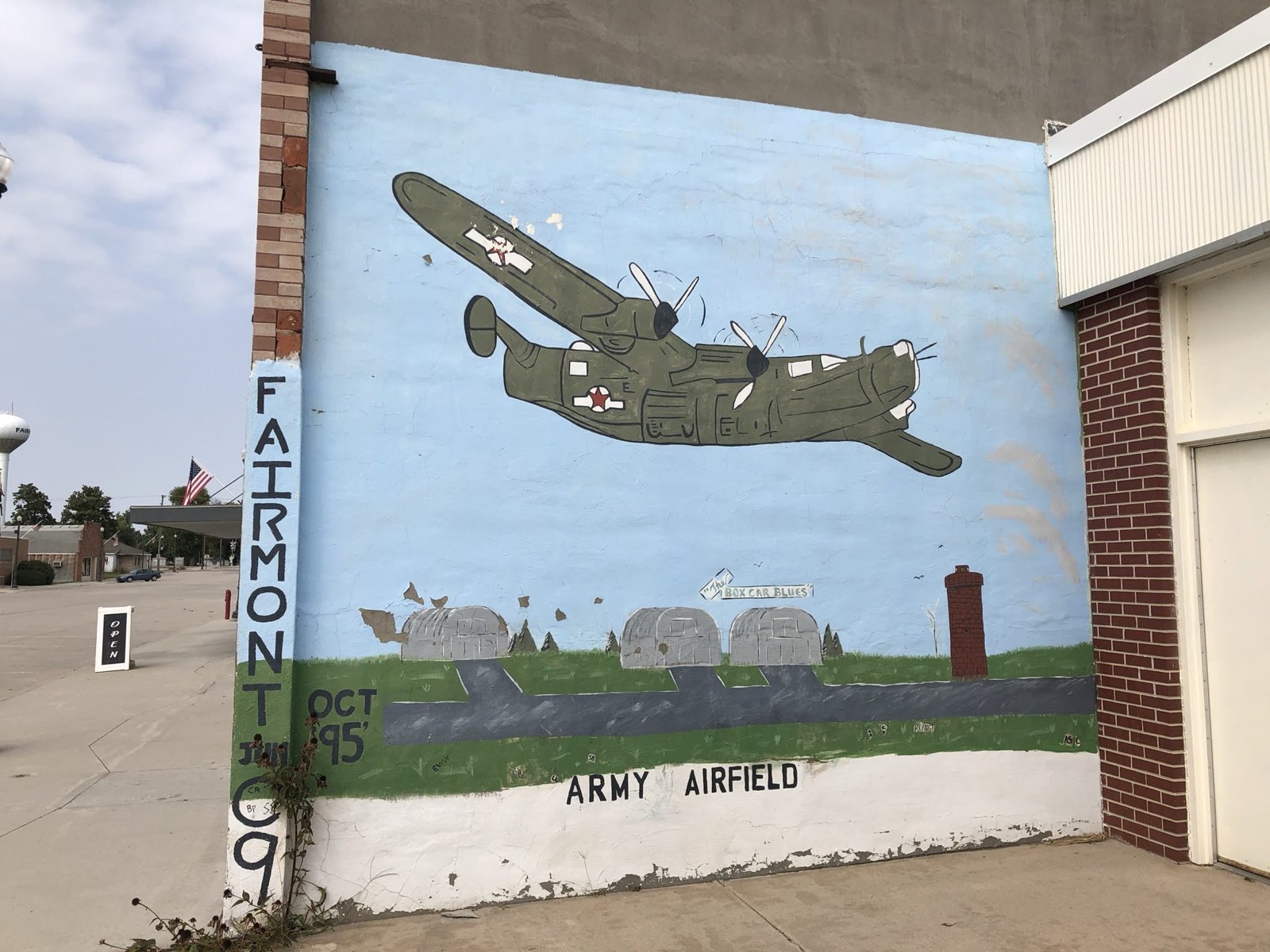
The South Platte Land Company, a subsidiary of the Burlington & Missouri River Railroad, platted Fairmont in 1871; the tracks arrived by the end of August, the first business opened in October, and the name kept the line’s alphabetical order of stations (Crete, Dorchester, Exeter, Fairmont, Grafton). Fairmont incorporated on May 25, 1873. The Nebraska Signal was founded here in 1881, a second Burlington line came in 1886 and the Kansas City & Omaha in 1887. The Fairmont Creamery, opened in 1884, was called the world’s largest creamery by 1921. Construction of Fairmont Army Air Field began south of town on September 17, 1942; seven bomb groups trained there on B-24s, B-17s and B-29s, and in September 1944 Lt. Col. Paul Tibbets chose its 393rd Bomb Squadron for the 509th Composite Group. The base was inactivated late in 1945 and given to the state in 1946 for civilian use. The village had its most people, 1,029, in 1890.
Highways and trails through Fairmont
| Route | One way | Other way |
|---|---|---|
| US 81North–south through the village | North to McCool Junction and York | South to Geneva |
| US 6East–west along the BNSF | West to Grafton and Sutton | East to Exeter and Friend |
Nearby towns
| Grafton | about 7 mi west | US 6 |
| Geneva | about 7 mi south | US 81 |
| Exeter | about 7 mi east | US 6 |
| McCool Junction | about 8 mi north | US 81 |
| Sutton | about 14 mi west | US 6 |
| York | about 16 mi north | US 81 |
Things to see
the Fillmore County Museum, 600 6th Ave. (Wednesdays 2–4, June–September, and by appointment) · the Fairmont Creamery Company Building (National Register, 1983), 6th Ave. and F St. · the Lincoln Telephone & Telegraph exchange building (National Register, 2006), 635 6th Ave. · the Fairmont Army Air Field, about 2 miles south, with History Nebraska markers on Road H · the Real WPA, 2 miles north
Schools and health care
Schools: Fillmore Central Middle School (5–8), 950 F St.; elementary and high school in Geneva
Health care: Fairview Manor (nursing home), 255 F St., (402) 268-2271; Hospital: Fillmore County Hospital, Geneva, about 7 mi
Sources: U.S. Census; Wikipedia; Andreas, History of the State of Nebraska (1882); History Nebraska Fillmore County historic buildings survey (2020) and markers; National Register; Nebraska Game and Parks; U.S. Fish and Wildlife Service; UNL climate records; Nebraska Secretary of State; Nebraska Department of Education; Fillmore County; City of Geneva; Nebraska 211; Visit Nebraska. Distances marked "about" are straight-line estimates.
Fairmont Businesses & Places
19 listings in Fairmont.
Click a category to see the businesses.
Outdoors & Recreation (1)
- Real WPA — Public Hunting Areas & WMAs
Places to Visit (2)
- Fairmont Army Air Field — Historic Marker
- Fillmore County Museum — History & Heritage Museums
Government & Resources (7)
- Fairmont Housing Authority — Housing Authority
- Fairmont Police Department — Police Station
- Fairmont Post Office — Post Office
- Fairmont Public Library — Libraries
- Fairmont Senior Center — Senior Citizen Center
- Fairmont Village Office — City Hall
- Fairview Manor — Assisted Living
Community & Faith (5)
- Fairmont Catholic Cemetery — Cemeteries
- Fairmont Cemetery — Cemeteries
- Fairmont Community Church — Methodist Church
- Fairview Cemetery — Cemeteries
- Greenwood Cemetery — Cemeteries
Utilities (1)
- Fairmont Municipal Utilities — Electric Power Provider
Transportation (1)
- Fairmont State Airfield — Municipal / General Aviation Airport
Education (1)
- Fillmore Central Middle School — Elementary & Middle School
Agriculture & Farm (1)
- Manning Grain Company – Burress — Grain Elevator / Cooperative