Gage County Cameras
Towns in Gage County Nebraska
Gage County, Nebraska
County seat: Beatrice · Created: 1855 by the first territorial legislature; organized July 1857 · Named for: Rev. William D. Gage, a Methodist minister and first chaplain of the territorial legislature · License plates: prefix 3 · Population: 21,704 (2020 census; peak 36,344 in 1890) · Area: about 851 sq mi of land
About Gage County
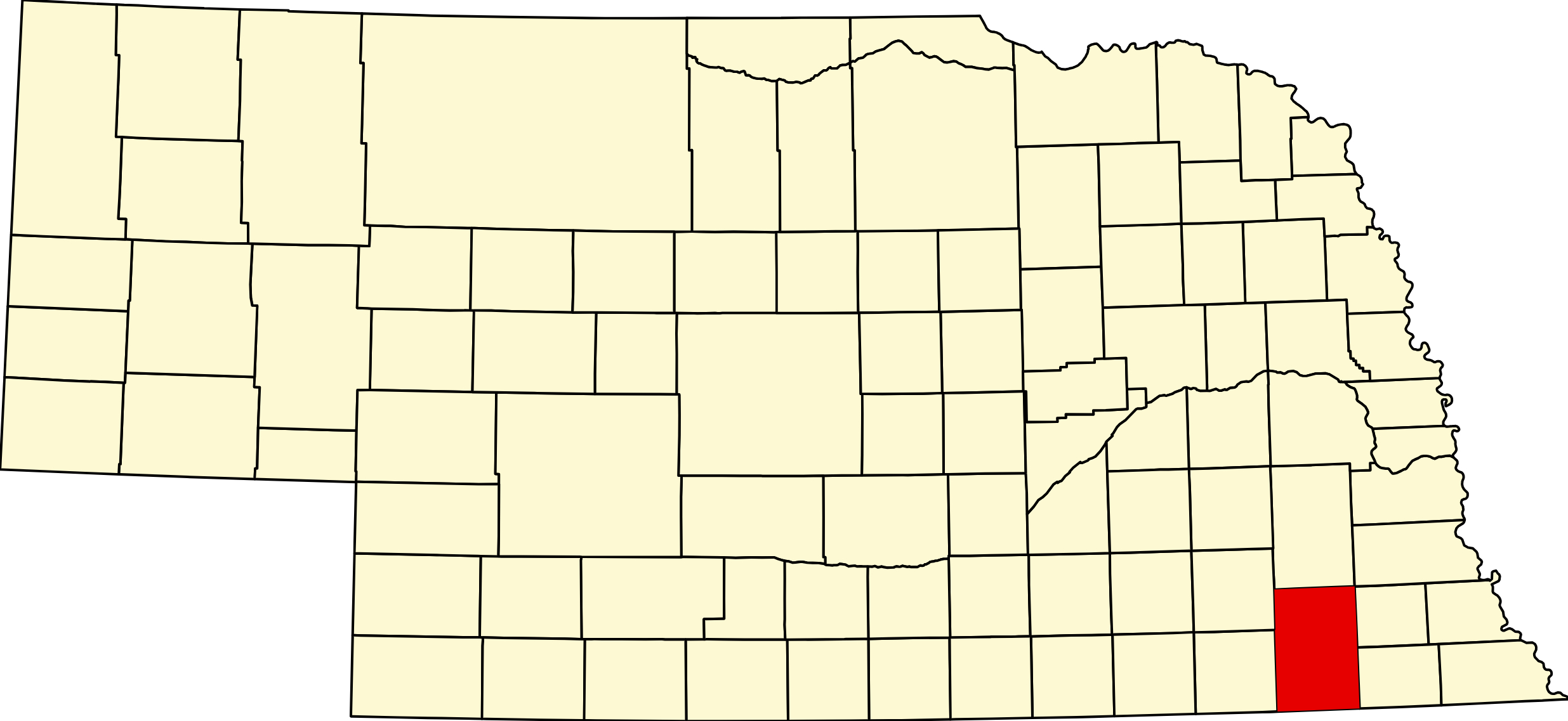
Gage County lies on the Kansas line in southeastern Nebraska, crossed from north to south by the Big Blue River. Its southern edge was part of the Otoe-Missouria reservation, home to the tribes from 1855 until their removal to Indian Territory in 1881; Barneston stands on the old agency site. Beatrice was founded in 1857 by a colony of steamboat passengers, and on January 1, 1863, Daniel Freeman filed one of the first claims under the Homestead Act west of town, now Homestead National Historical Park. In 1864 eight townships of the dissolved Clay County were added on the north.
Railroads built most of the towns: the Atchison & Nebraska founded Adams in 1873, the Burlington founded Wymore, Odell, Liberty and Filley in 1880–83, the Union Pacific Holmesville, Cortland, Pickrell and Barneston in 1880–84, and the Rock Island Virginia, Ellis and Clatonia in 1887–92. The county counted 36,344 people in 1890. Its license-plate prefix, 3, was assigned in 1922 because it had the third-most vehicles in the state.
Towns of Gage County
Cities and villages
Beatrice
The Gage County seat, a city of 12,261 on the Big Blue River founded in 1857, near Homestead National Historical Park on the first homestead claim. A National Register downtown, the 1890s courthouse, the county museum in the 1906 depot and the Homestead Trail.
Wymore
City of 1,377 platted on the Burlington in 1881 and named for farmer Samuel Wymore; a railroad division point settled by many Welsh families. The Great Plains Welsh Heritage Center, brick streets and Arbor State Park.
Blue Springs
Nebraska's least populous city at the 2020 census, 282 people, on the Big Blue River just north of Wymore. Settled in 1857 and named for its springs; the 1855 Johnson Cabin is on the National Register.
Barneston
Village of 90 on NE 8, built in 1884 on the site of the Otoe-Missouria agency of the Big Blue Reservation. The Barneston Site is on the National Register.
Liberty
Village of 37 on a spur north of NE 8, laid out at a Burlington station in 1880–81. Birthplace of U.S. Senate Republican leader Kenneth S. Wherry.
Odell
Village of 260 on NE 8 and NE 112, platted in 1880 on former Otoe reservation land. The Old West Trails Center fills an 1885 limestone bank on the National Register; the Oregon Trail passed just south.
Adams
Village of 604 in northeastern Gage County, laid out on the Atchison & Nebraska in 1873 and named for settler John O. Adams. Freeman Public Schools, a clinic, Gold Crest Retirement Center and Community Days.
Cortland
Village of 504 on US 77 halfway between Lincoln and Beatrice, platted on the Union Pacific in 1884. The Cortland Museum, Cortland United Church and the Homestead Trail.
Clatonia
Village of 263 on NE 41 in the county's northwest corner, a German farm settlement from about 1869 that became a Rock Island town in 1892. Named for Clatonia Creek.
Pickrell
Village of 186 on a hillside above the old Union Pacific grade, laid out in 1884 and named for William Pickrell. The Homestead Trail passes through, 7 miles north of Beatrice.
Filley
Village of 124 on US 136 founded in 1882 by cattleman Elijah Filley, whose 1874 limestone barn south of town is on the National Register. Birthplace of actor Robert Taylor.
Virginia
Village of 74 platted in 1887 by Ford Lewis on the Rock Island and named for Virginia Lewis. A grain-elevator town just south of NE 4.
Former towns and post office communities
Holmesville
Small community on the east bank of the Big Blue, laid out on the Union Pacific in 1880 by quarryman Morgan L. Holmes. About 60 people.
Rockford
Rural community east of Beatrice, settled in 1858 and named for rock quarries near Mud Creek. Rockford Lake State Recreation Area, with 72 campsites, is about 2 miles southeast.
Ellis
Rock Island station town on US 136 west of Beatrice, named for banker John R. Ellis, with a post office from 1887 to 1958. Ellis United Methodist Church still meets.
Hoag
Railroad hamlet northwest of Beatrice, the first station out of Beatrice on the Burlington line to Lincoln, with a post office from 1885 to 1934.
Travel Corridors
US 136 — the Heritage Highway, east–west through Ellis, Beatrice and Filley. US 136 Corridor →
NE 4 — east–west past Homestead National Historical Park, through Beatrice with US 136, then past Virginia toward Table Rock. NE 4 Corridor →
US 77 — north–south through Cortland, Beatrice, Blue Springs and Wymore, from Lincoln to Marysville, Kansas; north of Beatrice it is the Homestead Expressway.
State highways — NE 8 across the south through Odell and Barneston, with a spur to Liberty; NE 41 through Clatonia and past Adams; NE 43 north from Adams; and NE 112 from the Kansas line through Odell to US 77 near Blue Springs.
Cameras: View Gage County cameras → · Road conditions: Nebraska 511
Things to See
Homestead National Historical Park west of Beatrice; in Beatrice, the downtown historic district, the courthouse, the Gage County Historical Society Museum in the 1906 depot and Yesterday's Lady; the 1874 Elijah Filley Stone Barn near Filley; the Great Plains Welsh Heritage Center in Wymore; the Johnson Cabin in Blue Springs; the Old West Trails Center in Odell; and the Cortland Museum.
Outdoors
Rockford Lake State Recreation Area near Rockford has a 150-acre lake and 72 campsites. The Homestead Trail runs about 40 miles from Beatrice through Pickrell and Cortland to Lincoln. Hunters can use Diamond Lake, Donald Whitney Memorial and Arrowhead wildlife management areas near Odell, and the Lower Big Blue NRD manages areas at Bear Creek, Big Indian, Clatonia and Wolf-Wildcat. Campers can also stay at Chautauqua Park in Beatrice and Arbor State Park in Wymore.
Gage County Business Directory
Businesses within 20 miles of: Beatrice · Wymore · Adams · Cortland · Odell · All listings →
Adjacent Counties
Lancaster County (north) · Otoe County and Johnson County (northeast) · Pawnee County (east) · Marshall County, Kansas (southeast) · Washington County, Kansas (southwest) · Jefferson County (west) · Saline County (northwest)
Events
2026 dates: Homestead Days in Beatrice (parade June 27; park events June 27–28); the Gage County Fair in Beatrice (July 22–26); the Filley Stone Barn harvest festival in October; and the Nebraska Governor's Pheasant Hunt in Beatrice (November 6–7).
Events in Gage County
- Adams Community Days (Adams)
Adams Community Days is an annual multi-day community celebration held each August in Adams, organized by the ADAMS Community Foundation. - Adams Independence Day Celebration (Adams)
Adams holds its Independence Day celebration on the first Saturday of July each year, featuring volleyball and softball tournaments, a community barbecue, and firewo… - Gage County Fair (Beatrice)
The Gage County Fair is held annually in late July at the Gage County Fairgrounds in Beatrice, the county seat, two blocks south on Logan Street off West Court. - Homestead Days (Beatrice)
Know of another event in the county? Tell us about it.
Gage County at a Glance
Gage County, Nebraska — on the Kansas line, along the Big Blue River. County seat Beatrice; the other cities are Wymore and Blue Springs.
Getting there: US 77 from Lincoln or Kansas, US 136 from Tecumseh or Fairbury, and NE 4 from the west.
For visitors: Homestead National Historical Park, Beatrice's historic downtown and museums, the Filley Stone Barn, Wymore's Welsh heritage, Rockford Lake and the Homestead Trail. Hospital: Beatrice Community Hospital and Health Center.
Vehicles registered in Gage County carry license plate number 3. See what every Nebraska county number means.
Gage County Businesses & Places
305 listings in Gage County.
Click a category to see the businesses.
Eat & Drink (22)
- Burger King - Beatrice (501 N 6th St) — Burger King, Beatrice
- Country Cookin' Cafe — Diner / Family Restaurant, Beatrice
- Dairy Queen Beatrice — Dairy Queen, Beatrice
- Domino's Pizza - Beatrice (1710 North 6th Street) — Domino's Pizza, Beatrice
- Godfather's Pizza — Pizza Restaurant, Beatrice
- Hardee's Beatrice — Hardee's, Beatrice
- Jimmy John's — Diner / Family Restaurant, Beatrice
- Kala's Savory Bites and Sifted Sweets — Cafe / Coffee Shop, Beatrice
- KFC Beatrice — KFC, Beatrice
- McDonald's - Beatrice (1220 N 6th St) — McDonald's, Beatrice
- Pizza Hut — Pizza Restaurant, Beatrice
- Playa Azul — Mexican Restaurant, Beatrice
- Runza Beatrice — Runza, Beatrice
- Shanghai Inn — Chinese Restaurant, Beatrice
- Sonic Drive-In — Diner / Family Restaurant, Beatrice
- Stone Hollow Brewing Company — Brewery & Taproom, Beatrice
- Subway – 1219 N 6th St, Beatrice — Subway, Beatrice
- Subway – 402 S. 14th Street, Wymore — Subway, Nebraska
- Sunrise Bakery — Bakery, Beatrice
- Tall Tree Tastings — Winery & Vineyard, Beatrice
- The Black Crow — American Restaurant, Beatrice
- Tiger's Den — Restaurant, Nebraska
Stay (2)
- Capri Inn & Suites of Beatrice — Hotel, Beatrice
- Victorian Inn — Hotel, Beatrice
Outdoors & Recreation (12)
- Arrowhead WMA — Public Hunting Areas & WMAs, Nebraska
- Beatrice Country Club — Country Club, Beatrice
- Chautauqua Park — Campgrounds & RV Parks, Beatrice
- Diamond Lake WMA — Public Hunting Areas & WMAs, Nebraska
- Donald Whitney Memorial WMA — Public Hunting Areas & WMAs, Nebraska
- Feits Memorial Park — Campgrounds & RV Parks, Blue Springs
- Gage County Fairgrounds — Campgrounds & RV Parks, Beatrice
- Hidden Acres Golf Course — Golf Course, Beatrice
- Homestead Trail — Trails & Rail Trails, Beatrice
- Oak Aven Acres RV Park — Campgrounds & RV Parks, Beatrice
- Rockford Lake State Recreation Area — Campgrounds & RV Parks, Nebraska
- Wymore Arbor State Park — Campgrounds & RV Parks, Nebraska
Places to Visit (11)
- Barneston Otoe-Missouria Reservation Heritage — History & Heritage Museums, Barneston
- Cortland Museum — Specialty Museums, Cortland
- Elijah Filley Stone Barn — Attraction, Filley
- Gage County Historical Society & Museum — History & Heritage Museums, Beatrice
- Great Plains Welsh Heritage Center — History & Heritage Museums, Nebraska
- Homestead National Historical Park — History & Heritage Museums, Beatrice
- Johnson Cabin Museum — Specialty Museums, Blue Springs
- Nebraska Baseball (Amateur) Hall of Fame — Specialty Museums, Beatrice
- Rockford Lake State Recreation Area — RV Camping, Nebraska
- Southeast Nebraska Old West Trails and Transportation Center — Specialty Museums, Nebraska
- Yesterday's Lady - Step Back in Time — Specialty Museums, Beatrice
Events & Venues (6)
- Adams Community Days — Festivals & Celebrations, Adams
- Adams Independence Day Celebration — Festivals & Celebrations, Adams
- Big Blue Water Park — Swimming Pool, Beatrice
- Gage County Fair — County Fair, Beatrice
- Gage County Fairgrounds — Fairground, Beatrice
- Homestead Days — Festivals & Celebrations, Beatrice
Health & Emergency (11)
- Adams Primary Care — Medical Clinic, Adams
- Beatrice Community Hospital & Health Center — Hospital, Beatrice
- Beatrice Family & Internal Medicine Clinic — Medical Clinic, Beatrice
- Clabaugh Pharmacy — Pharmacy, Beatrice
- Community Physician's Clinic — Medical Clinic, Nebraska
- Deines Pharmacy — Pharmacy, Beatrice
- Lake Crest Pharmacy — Pharmacy, Adams
- Miracle-Ear Hearing Aid Center Beatrice — Hearing Aids, Beatrice
- Pinkerton Dentistry — Dentist & Dental Office, Beatrice
- The Beatrice Women's and Children's Clinic — Medical Clinic, Beatrice
- Wymore Medical Clinic — Medical Clinic, Nebraska
Shopping & Gifts (5)
- Goldenrod Antiques & Vintage — Antique Mall, Beatrice
- Quilt Stitches — Fabric & Quilt Shop, Beatrice
- Triple A Antiques — Antique Mall, Beatrice
- TSC Farm Store — Hardware Store, Beatrice
- Westlake Ace Hardware — Hardware Store, Beatrice
Community & Faith (100)
- Adams First UMC — Methodist Church, Adams
- Amateur Radio Repeaters - Gage County (via RepeaterBook.com) — Amateur Radio Repeater, Nebraska
- American Lutheran Church — Lutheran Church, Filley
- American Lutheran Church — Lutheran Church, Adams
- Anyon Cemetery — Beatrice — Cemeteries, Beatrice
- Austin Creek Cemetery — Beatrice — Cemeteries, Beatrice
- Baker Cemetery — Pickrell — Cemeteries, Nebraska
- Barneston Cemetery — Barneston — Cemeteries, Barneston
- Beatrice Centenary UMC — Methodist Church, Beatrice
- Beatrice Church of Christ — Other Denomination, Beatrice
- Beatrice Seventh-day Adventist Church — Seventh-day Adventist Church, Beatrice
- Beatrice, First Presbyterian Church — Presbyterian Church, Beatrice
- Bethel Cemetery — Wymore — Cemeteries, Nebraska
- Blue Springs Cemetery — Blue Springs — Cemeteries, Blue Springs
- Blue Springs UMC — Methodist Church, Blue Springs
- Bohemian Cemetery — Adams — Cemeteries, Adams
- Calvary Cemetery — Wymore — Cemeteries, Nebraska
- Chrisman Burial Ground — Beatrice — Cemeteries, Beatrice
- Christ Episcopal Church — Episcopal Church, Beatrice
- Christ Lutheran Church Cemetery — Pickrell — Cemeteries, Nebraska
- Church of Christ in Beatrice — Other Denomination, Beatrice
- Church of Jesus Christ of Latter-day Saints — Beatrice — Latter-day Saints / Community of Christ, Beatrice
- Church of the Promise — Pentecostal, Beatrice
- Clatonia Cemetery — Clatonia — Cemeteries, Clatonia
- Connections Church — Pentecostal, Beatrice
- Cortland Cemetery — Cortland — Cemeteries, Cortland
- Cortland United Church — Congregational Church, Cortland
- Ellis Cemetery — Ellis — Cemeteries, Ellis
- Ellis, NE UMC — Methodist Church, Ellis
- Elysian View Cemetery — Beatrice — Cemeteries, Beatrice
- Emmanuel Lutheran Cemetery — Beatrice — Cemeteries, Beatrice
- Emmanuel Lutheran Church — Lutheran Church, Beatrice
- Evangelical Lutheran Cemetery — Liberty — Cemeteries, Liberty
- Evergreen Home Cemetery — Beatrice — Cemeteries, Beatrice
- Evergreen Memorial Park — Beatrice — Cemeteries, Beatrice
- Filley Cemetery — Filley — Cemeteries, Filley
- First Baptist Church - Beatrice — Baptist Church, Beatrice
- First Mennonite Church Cemetery — Beatrice — Cemeteries, Beatrice
- First Trinity Lutheran Cemetery — Beatrice — Cemeteries, Beatrice
- First Trinity Lutheran Church — Lutheran Church, Beatrice
- Freeman Cemetery — Beatrice — Cemeteries, Beatrice
- Grandview Cemetery — Barneston — Cemeteries, Barneston
- Highland Cemetery — Adams — Cemeteries, Adams
- Highland Center Cemetery — Cortland — Cemeteries, Cortland
- Holmesville Cemetery — Holmesville — Cemeteries, Holmesville
- Holy Cross Lutheran Church — Lutheran Church, Beatrice
- Homestead Church — Non-Denominational Church, Beatrice
- Hooker Cemetery — Adams — Cemeteries, Adams
- Immanuel Cemetery — Clatonia — Cemeteries, Clatonia
- Immanuel Lutheran Cemetery — Wymore — Cemeteries, Nebraska
- Immanuel Lutheran Church — Lutheran Church, Nebraska
- Kingdom Hall of Jehovah's Witnesses — Jehovah’s Witnesses Church, Beatrice
- Laona Cemetery — Adams — Cemeteries, Adams
- Liberty Cemetery — Liberty — Cemeteries, Liberty
- Lord’s Acre Cemetery — Barneston — Cemeteries, Barneston
- Marsh Cemetery — Clatonia — Cemeteries, Clatonia
- Maschmeier Cemetery — Ellis — Cemeteries, Nebraska
- Odell Cemetery — Odell — Cemeteries, Nebraska
- Odell Czech National Cemetery — Odell — Cemeteries, Nebraska
- Odell UMC — Methodist Church, Nebraska
Government & Resources (48)
- ACCESSNebraska Office - Beatrice — Developmental & Social Services, Beatrice
- Adams Post Office — Post Office, Adams
- Barneston Fire Station — Fire Station, Barneston
- Barneston Post Office — Post Office, Barneston
- Barneston Village Office — City Hall, Barneston
- Beatrice Area Chamber of Commerce & Tourism — Chamber of Commerce, Beatrice
- Beatrice City Hall — City Hall, Beatrice
- Beatrice Fire Department — Fire Station, Beatrice
- Beatrice Housing Authority — Housing Authority, Beatrice
- Beatrice Police Department — Police Station, Beatrice
- Beatrice Post Office — Post Office, Beatrice
- Beatrice Public Library — Libraries, Beatrice
- Beatrice Senior Center — Senior Citizen Center, Beatrice
- Beatrice USDA Service Center — USDA Service Center (FSA/NRCS), Beatrice
- Blue Springs Post Office — Post Office, Blue Springs
- Blue Springs Rural Fire District — Fire Station, Blue Springs
- Clatonia Fire Department — Fire Station, Clatonia
- Clatonia Post Office — Post Office, Clatonia
- Clatonia Village Office — City Hall, Clatonia
- Cortland Post Office — Post Office, Cortland
- Cortland Senior Center — Senior Citizen Center, Cortland
- Cortland Village Office — City Hall, Cortland
- Filley Village Office — City Hall, Filley
- Gage County Assessor — County Assessor, Beatrice
- Gage County Attorney's Office — County Attorney, Beatrice
- Gage County Clerk — County Clerk, Beatrice
- Gage County Court — County Court, Beatrice
- Gage County Courthouse — Court House, Beatrice
- Gage County Driver License Office — County Driver License, Beatrice
- Gage County Emergency Management — Emergency Management, Beatrice
- Gage County Sheriff — County Sheriff, Beatrice
- Gage County Treasurer — County Treasurer, Beatrice
- Gage County Veterans Service Office — Veterans Office, Beatrice
- Gage County Weed Superintendent — County Weed Control, Beatrice
- Gold Crest Retirement Center — Assisted Living, Adams
- Lower Big Blue Natural Resources District — Natural Resources District (NRD), Beatrice
- Odell Post Office — Post Office, Nebraska
- Odell Public Library — Libraries, Nebraska
- Odell Village Office — City Hall, Nebraska
- Pickrell Village Office — City Hall, Nebraska
- Virginia Village Office — City Hall, Nebraska
- Wymore City Hall — City Hall, Nebraska
- Wymore Fire Department — Fire Station, Nebraska
- Wymore Home Delivered — Senior Citizen Center, Nebraska
- Wymore Housing Authority — Housing Authority, Nebraska
- Wymore Police Department — Police Station, Nebraska
- Wymore Post Office — Post Office, Nebraska
- Wymore Public Library — Libraries, Nebraska
Automotive (19)
- Beatrice Auto Sales — Used Car Dealer, Beatrice
- Belding Auto Sales — Used Car Dealer, Beatrice
- Casey's General Store - Beatrice (Arthur Street) — Casey's, Beatrice
- Casey's General Store - Beatrice (South 6th Street) — Casey's, Beatrice
- Casey's General Store - Beatrice (West Court Street) — Casey's, Beatrice
- Casey's General Store - Wymore — Casey's, Nebraska
- Drewels Used Cars & Trucks — Used Car Dealer, Beatrice
- Griffeth Transmission — Auto Repair, Beatrice
- Hawkins Automotive — Used Car Dealer, Nebraska
- Morris Used Cars — Used Car Dealer, Blue Springs
- Nct & E Truck Sales — Truck Dealership, Adams
- Northeast Auto — Used Car Dealer, Beatrice
- Premier Chevrolet Buick GMC — Franchised New Car Dealer, Beatrice
- Rays Used Cars — Used Car Dealer, Cortland
- Refuse Truck Sales — Truck Dealership, Adams
- Sutton Repair — Auto Repair, Nebraska
- Twin Rivers Chrysler Jeep Dodge — Franchised New Car Dealer, Beatrice
- Vinton Auto Sales & Service — Auto Repair, Cortland
- Zoellner Ford of Beatrice — Franchised New Car Dealer, Beatrice
Professional Services (17)
- American Family Insurance (Wirth) — Insurance, Beatrice
- Dana F. Cole & Company - Beatrice — Accountant, Beatrice
- First Interstate Bank - Beatrice — Banking, Beatrice
- FNBO - Beatrice — Banking, Beatrice
- FNIC – Beatrice — Insurance, Beatrice
- Hartig Real Estate, LLC — Real Estate Agency, Beatrice
- Homestead Land Co. — Farm & Land / Ranch Real Estate, Beatrice
- Jones Group — Insurance, Beatrice
- K4 Storage - Beatrice Carlyle St — Self-Storage Facility, Beatrice
- Nebraska Self Storage – Beatrice Market St — Self-Storage Facility, Beatrice
- Nebraska Title Company - Beatrice — Beatrice
- Pinnacle Bank - Beatrice — Banking, Beatrice
- Scully Estates — Real Estate Agency, Beatrice
- Security First Bank - Beatrice — Banking, Beatrice
- Security First Insurance — Insurance, Beatrice
- Security First Insurance – Blue Springs — Insurance, Blue Springs
- Security First Insurance – Clatonia — Insurance, Clatonia
Education (17)
- Beatrice Community Preschool — Elementary & Middle School, Beatrice
- Beatrice Elementary School — Elementary & Middle School, Beatrice
- Beatrice High School — High School, Beatrice
- Beatrice Middle School — Elementary & Middle School, Beatrice
- Beatrice Public Schools — School District (K-12 / General), Beatrice
- Diller-Odell Public Schools — School District (K-12 / General), Nebraska
- Diller-Odell Secondary School — Elementary & Middle School, Nebraska
- Educational Service Unit 5 — Educational Service Unit, Beatrice
- Freeman Elementary-Adams — Elementary & Middle School, Adams
- Freeman High School — High School, Adams
- Freeman Public Schools — School District (K-12 / General), Adams
- Gage County Extension — County Extension Office, Beatrice
- Southeast Community College – Beatrice Campus — Community College, Beatrice
- Southern Elementary School — Elementary & Middle School, Blue Springs
- Southern Jr.-Sr. High School — High School, Nebraska
- Southern Public Schools 3-Year-Old Preschool — Elementary & Middle School, Blue Springs
- Southern School District 1 — School District (K-12 / General), Nebraska
Utilities (17)
- Beatrice Municipal Utilities — Electric Power Provider, Beatrice
- City of Beatrice — Water Utility / District, Beatrice
- City of Blue Springs — Water Utility / District, Blue Springs
- City of Wymore — Water Utility / District, Nebraska
- Lower Big Blue NRD - Beatrice West — Water Utility / District, Beatrice
- Lower Big Blue NRD - Wymore — Water Utility / District, Beatrice
- Norris Public Power District — Electric Power Provider, Beatrice
- Village of Adams — Water Utility / District, Adams
- Village of Barneston — Water Utility / District, Barneston
- Village of Clatonia — Water Utility / District, Clatonia
- Village of Cortland — Water Utility / District, Cortland
- Village of Filley — Water Utility / District, Filley
- Village of Liberty — Water Utility / District, Liberty
- Village of Odell — Water Utility / District, Nebraska
- Village of Pickrell — Water Utility / District, Nebraska
- Village of Virginia — Water Utility / District, Nebraska
- Wymore Municipal Utilities — Electric Power Provider, Nebraska
Media (8)
- Arbor State — News Paper, Nebraska
- Daily Sun — News Paper, Beatrice
- K23AA-D Channel 29 - Beatrice — TV Translator, Beatrice
- KNBE 88.9 FM - Beatrice — Radio Station, Beatrice
- KPKA-LP 100.1 FM - Beatrice — Radio Station, Beatrice
- KWBE 1450 AM - Beatrice — Radio Station, Beatrice
- KWBE-LD Channel 21 - Beatrice — TV Station, Beatrice
- My Bridge Radio 88.3 FM - Beatrice — My Bridge Radio, Beatrice
Manufacturing & Industrial (4)
- Beatrice Machine — Machine Shop, Beatrice
- Diversified Machine — Machine Shop, Beatrice
- LandMark Snacks — Food & Beverage Manufacturing, Beatrice
- Nebraska Machine & Tool — Machine Shop, Beatrice
Transportation (3)
- Beatrice Municipal Airport — Municipal / General Aviation Airport, Beatrice
- Blue Rivers Area Agency on Aging - Beatrice — Public Transportation, Beatrice
- Blue Rivers Area Agency on Aging - Wymore — Public Transportation, Nebraska
Agriculture & Farm (3)
- Bomgaars – Beatrice — Bomgaars, Beatrice
- LandMark Implement - Beatrice — Equipment Dealers, Beatrice
- Roehrs Machinery — Equipment Dealers, Beatrice
Personal Services (2)
- Griffiths-Hovendick Chapel — Funeral Home, Beatrice
- Harman-Wright Mortuary & Crematory — Funeral Home, Beatrice