Nuckolls County, Nebraska
Visitor & Travel Categories
Business & Economic Categories
Nuckolls County, Nebraska
County Seat: Nelson
Founded: 1860
Named For: Stephen F. Nuckolls, early Nebraska pioneer and legislator
License Plate Prefix: 42
Population: 4,095 (2020 census)
Area: 576 sq mi
History
Nuckolls County was established in 1860 and named after Stephen F. Nuckolls, an early territorial leader. Settlement expanded along the Little Blue River, where fertile bottomlands supported early farming and milling. Nelson, founded in the 1870s, became the county seat and developed into a regional center for trade and civic life. Superior, located near the Kansas border, grew into one of the county’s largest communities and became known for its milling, railroads, and later its Victorian architecture. Lawrence, Oak, Angus, and Hardy developed as agricultural and rail‑supported towns, each contributing to the county’s rural identity.
The county’s history reflects pioneer migration, railroad expansion, and the growth of small towns that supported farming, milling, and early transportation routes across south‑central Nebraska.
Geography
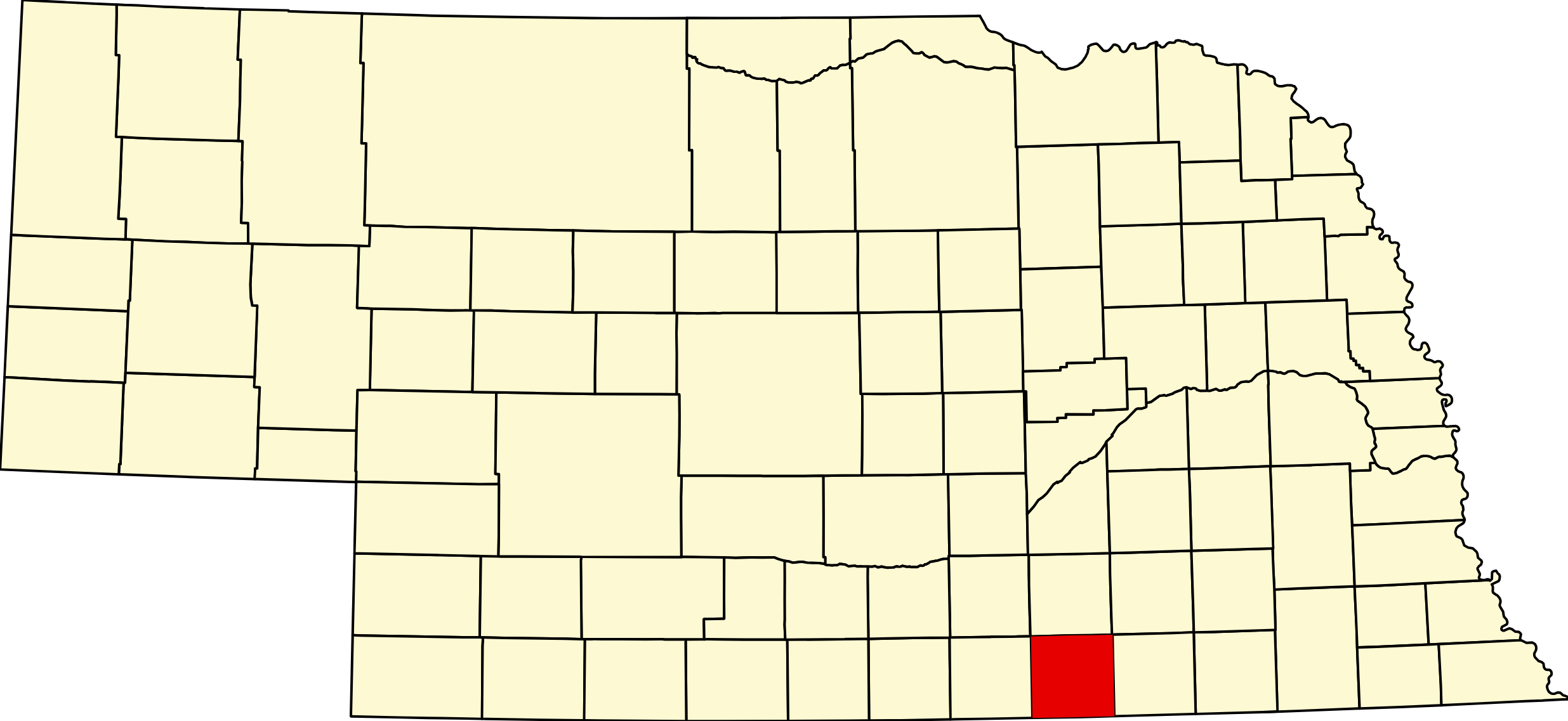
Location: South‑central Nebraska along the Kansas border
Landscape: Rolling prairie, fertile farmland, Little Blue River valleys, and rural communities
Adjacent Counties:
- Thayer County (east)
- Fillmore County (northeast)
- Clay County (north)
- Webster County (west)
- Jewell County, Kansas (south)
Culture & Landmarks
- Superior’s Victorian District – One of Nebraska’s best collections of historic Victorian‑era homes.
- Little Blue River Valley – Scenic landscapes with wildlife, trails, and historic significance.
- Nuckolls County Museum (Nelson) – Exhibits highlighting pioneer life and local heritage.
Notable Communities
- Nelson – County seat with strong civic and historical identity.
- Superior – Largest community, known for Victorian architecture and regional events.
- Lawrence – Village with strong Czech and German heritage.
- Oak – Small town with deep farming roots.
- Hardy, Angus – Rural communities with close‑knit traditions.
- Nora – The county's smallest incorporated village, with about 21 residents.
- Ruskin – Village named for art critic John Ruskin, settled by early Danish homesteaders.
- Bostwick – Small unincorporated community near Superior, close to the Webster County line.
Events & Attractions
- Superior Victorian Festival – Celebrating the town’s historic architecture and cultural heritage.
- Nuckolls County Fair – Livestock shows, rodeo events, and agricultural exhibits.
- Outdoor Recreation – Hunting, fishing, birdwatching, and scenic drives across prairie farmland.
- View the full Nuckolls County Events calendar →
Living in Nuckolls County
Nuckolls County blends agricultural strength, historic towns, and quiet rural life. Nelson anchors county services, while Superior, Lawrence, Oak, and smaller communities maintain long‑standing farming and cultural traditions. Residents value the area’s heritage, open landscapes, and strong community identity.
Nuckolls County at a Glance
Nuckolls County, Nebraska — created in 1860 and organised in 1871: the organising election was held at Oak Grove on 27 June 1871, and thirty-three votes were cast. Local tradition says it was done beneath an elm. The namesake is disputed between the brothers Lafayette and Stephen Friel Nuckolls; Stephen was a co-founder of Nebraska City and later Wyoming Territory’s delegate to Congress, and it should be said plainly that he brought four enslaved people into Nebraska Territory and offered a $200 reward when two women escaped in 1858 — he pursued Eliza Grayson to Chicago, where an abolitionist crowd freed her from jail and she got away to Canada. County seat Nelson. Population peaked at 13,236 in 1920 and stands at 4,095. 118 listings across 10 towns.
Getting there: US-136 crosses the county, with NE-4, 8 and NE-14. The Little Blue River runs across the northeast — that valley is the Oregon Trail corridor — and the Republican clips the southwestern corner. The county borders Republic and Jewell counties, Kansas. A BNSF branch, the old Santa Fe, still runs from Superior south to Lost Springs, Kansas; locals still call it the Santa Fe. Central Time.
The small central town beat the big railroad town. Nelson was chosen county seat in October 1872 over Elkton and Vernon, on land owned by Horatio Nelson Wheeler, simply because it sat near the county’s centre. On 30 July 1889 Superior, thirteen miles south and by then much the larger place, forced a removal election — and Nelson held on by a hair. The stone courthouse that followed, completed in 1890 with an eighty-foot tower, is on the National Register. Over at Oak, when the railroad came in 1888, the whole town was physically hauled to the new townsite — the church and the store went first.
The Oregon Trail runs down Main Street in Oak, and three National Historic Trails — Oregon, California and Pony Express — converge on the Oak Grove site south of town, established as a road ranch by the Comstock family in 1858 and serving as a Pony Express station and Overland Stage stop.
And then came August 1864. With the regular army pulled east for the Civil War, Sioux, Cheyenne and Arapaho struck the trail settlements — beginning 7 August 1864, hitting nearly every station for four hundred miles from Julesburg to Big Sandy, and stopping travel for two months. The worst of it was here, on the upper Little Blue. That Sunday afternoon about twenty warriors surrounded Oak Grove Ranch, where several families had gathered; eleven barricaded themselves in the house and held out until a wagon train came in sight, and the attackers came back the next day and burned the buildings. Two miles west, at the Narrows, seven of the Eubank family were killed and Lucinda Eubank, her infant son, three-year-old Isabelle and sixteen-year-old Laura Roper were carried off. Laura Roper was released within a month or so. Lucinda and the baby were held nearly a year before reaching Fort Laramie in May 1865. Isabelle never came back. Pawnee Ranch was defended successfully; at Little Blue Station nine men were killed and a wagon train burned. The state marker on Highway 14 north of Nelson tells it and puts the toll on the upper Little Blue at about a hundred. At the Oak Grove site there is a stone monument in a fenced enclosure and a parking area — nothing original survives, the land is private, and visitors are asked not to cross the fence. Oak stages an Oregon Trail re-enactment every fourth year with tours of eight trail stations.
Superior is the Victorian Capital of Nebraska, and its defining figure is Evelene Brodstone — Lady Vestey. She grew up here, went to Chicago as a twelve-dollar-a-week stenographer at Vestey Cold Storage in 1895, and rose to be travelling auditor for the whole Vestey firm at $250,000 a year, working in China, Venezuela, Russia and Australia. She married Lord Vestey in 1924. With her brother she gave the land and money for Brodstone Memorial Hospital in their mother’s memory — and Willa Cather wrote the dedication plaque — and later gave the town two blocks for a bird sanctuary and children’s park. She died in London in 1941 and her ashes came home to Superior, making her the only member of the British nobility buried in Nebraska. The Lady Vestey Victorian Festival fills the Memorial Day weekend. She was born in Monroe, Wisconsin — raised here, not born here.
For visitors: the Nuckolls County Historical Society complex at Superior, eight buildings including what is billed as Nebraska’s oldest church structure and the first Superior post office in a log cabin; the Superior Downtown Historic District and the 1937 City Hall and Auditorium, both National Register; the Lawrence Opera House; the Nelson Cemetery Walk; the carved sandstone faces on the old Stansbury Building on West Fourth Street in Nelson; and the Russ Snyder Museum at Oak. Superior’s municipal pool is reckoned the seventh-largest in Nebraska. The county fair and rodeo run in July, and the State High School Rodeo comes to the Nelson fairgrounds over Labor Day weekend.
Outdoors: no state park or state recreation area. Harbine Park at Nelson takes campers with electric, water and sewer and there is a dump station on West 8th Street; the park also has a pool, lighted tennis, a dog park, sand volleyball, ball diamonds and a quarter-mile track, and the nine-hole Elk Creek Country Club is just out of town. Smartweed Marsh is the county’s wildlife management area, and the Little Blue and Republican are both canoeable. Lovewell Reservoir, which every regional guide lists, is in Jewell County, Kansas — ten minutes over the line, and not in Nebraska.
Born here. Ed Weir (Superior, 14 March 1903), the first Nebraska Cornhusker elected to the College Football Hall of Fame — consensus All-American in 1924 and unanimous in 1925, the tackle who beat Notre Dame’s Four Horsemen, later an All-Pro and player-coach for the Frankford Yellow Jackets and then Nebraska’s track coach. And Russ Snyder (Oak, 1934), an outfielder for the 1966 World Series champion Baltimore Orioles, whose lunging catch in Game One the Baltimore Sun called the play of an unsung hero. Jim Kaat pitched for the Superior Senators in the minors before his 283 wins and the Hall of Fame — but he was born in Michigan.
Vehicles registered in Nuckolls County carry license plate number 42. See what every Nebraska county number means.