
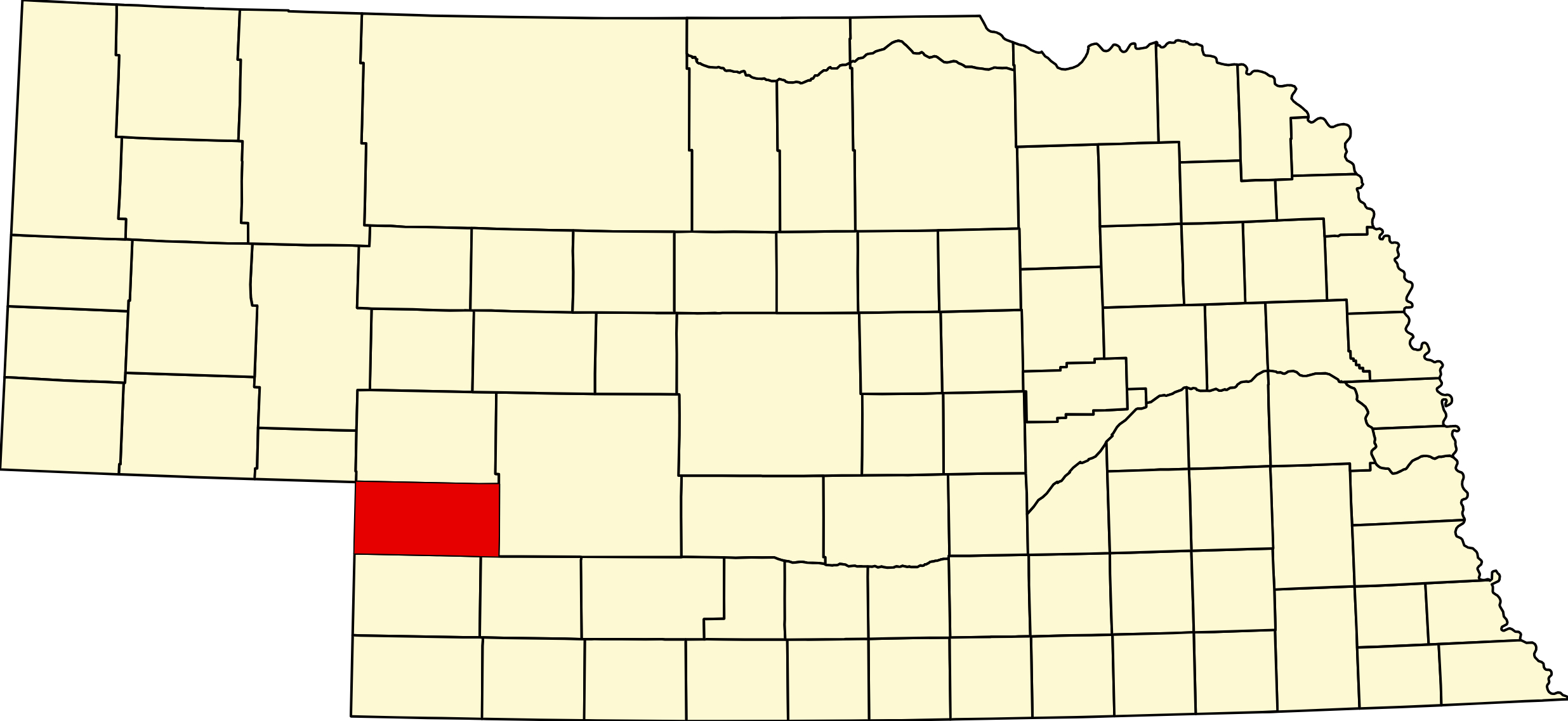
County Seat: Grant
Founded: 1887
Named For: Charles E. Perkins, president of the Chicago, Burlington & Quincy Railroad
License Plate Prefix: 74
Population: 2,858 (2020 census)
Area: 883 sq mi
History
Perkins County was established in 1887 during a period of rapid settlement across the High Plains. It was named after Charles E. Perkins, president of the Chicago, Burlington & Quincy Railroad, whose influence helped shape transportation and development across western Nebraska. Early settlers were primarily homesteaders and ranchers who established farms across the rolling prairie.
Grant was selected as the county seat and grew into the county’s primary commercial and administrative center. Agriculture—especially dryland farming, cattle operations, and later irrigated crop production—has remained the foundation of the county’s economy. The region’s rural character and strong agricultural traditions continue to define Perkins County today.
Geography
Location: Southwestern Nebraska, part of the High Plains region
Landscape: Rolling prairie, agricultural land, canyons, and the South Platte River basin influence
Adjacent Counties:
- Keith County (north)
- Lincoln County (northeast)
- Hayes County (east)
- Chase County (south)
- Phillips County, Colorado (west)
Culture & Landmarks
- Grant City Square – Historic downtown district with shops, services, and community landmarks.
- Perkins County Museum – Exhibits highlighting pioneer settlement, agriculture, and local heritage.
- Prairie Landscapes – Wide‑open High Plains scenery ideal for photography and scenic drives.
Notable Communities
- Grant – County seat and largest community.
- Venango – Small village near the Colorado border.
- Elsie – Rural community with strong agricultural roots.
- Madrid – Village located along Highway 23.
- Brandon – Historic unincorporated community.
Events & Attractions
- Perkins County Fair – Livestock shows, rodeo events, and community celebrations.
- High Plains Recreation – Hunting, birdwatching, and outdoor activities across the prairie.
- Local Heritage Events – Celebrations honoring the county’s pioneer and agricultural history.
Living in Perkins County
Perkins County offers a quiet rural lifestyle centered around agriculture, small‑town community life, and open High Plains landscapes. Grant provides essential services, schools, and local businesses, while surrounding communities maintain strong farming and ranching traditions. Residents value the area’s peaceful pace, wide‑open spaces, and deep agricultural heritage.
Perkins County at a Glance
Perkins County, Nebraska — organized in 1887 out of Keith County, the youngest county in this corner of the state. Named for Charles Elliott Perkins, president of the Chicago, Burlington & Quincy Railroad — the only county here named for a railroad man rather than a politician or a judge, and the naming was not abstract, because the CB&Q built every town in it. County seat Grant, platted in 1886 when the rails reached the spot and named for President Ulysses S. Grant; no county-seat fight is on record. Population peaked at 5,834 in 1930 and stands near 2,820. 140 listings across 5 towns.
Four towns, one railroad, two years. Grant was platted in 1886, Elsie came in about 1887, and Madrid and Venango were both platted in 1887 as the line was extended to each point. And the county is named for the father while one of its villages is named for his daughter — Elsie was named for Elsie Perkins, and her village’s streets were then named Burlington, Chicago, Perkins and Quincy. Madrid takes its name from the Spanish capital, though locally it is MAD-rid; Venango most likely from Venango County, Pennsylvania.
Getting there: NE-23 runs east and west and NE-61 north and south — no U.S. route crosses Perkins County at all. Seven counties border it, two of them in Colorado. Grant sits at 3,416 feet, the highest county seat in this tier and 742 feet above Trenton. Mountain Time. And in a town of 1,197 people sits the head office of the Nebraska, Kansas & Colorado Railway, an OmniTRAX short line running roughly 509 miles of track across three states on five subdivisions, hauling grain out of southwest Nebraska, northern Kansas and northeastern Colorado, and coal to Nebraska’s largest coal-fired plant.
Perkins County has no river. There is no significant perennial stream anywhere in its 884 square miles — the water here is underground, in the Ogallala Aquifer, and the surface is drained by draws that run only after rain. That absence is the county’s defining physical fact, and it is also its economic history: after the Second World War this county helped pioneer center-pivot irrigation, and that technology is what steadied an economy dryland farming could not support. Over ninety-five percent of the land is in agriculture — corn, wheat and cattle — at a population density just over three people to the square mile.
The bust of the 1890s hit here harder than anywhere: from 4,364 people in 1890 to 1,702 in 1900, a loss of sixty-one percent in ten years. It took until 1930 to recover. Since then Perkins has been the steadiest county out here, down about half from peak where its neighbor Dundy is down seventy percent.
For visitors: the Perkins County Museum on Central Avenue in Grant, run entirely by volunteers, in three buildings — a fully restored 1905 house with stained glass, pocket doors and original hardwood, furnished in period; a country school moved in from west of Brandon, with the original desks and the old high school annuals; and an exhibit hall under renovation for agriculture, military and local history. It opens Friday and Saturday mornings in summer and fall, and tours can be arranged. Grant’s downtown is a National Register commercial historic district.
Outdoors, the honest answer is that there is no public water. Perkins County has no state park, no state recreation area, no reservoir and no state wildlife management area — there is no stream here to impound. What it offers is upland game and deer hunting on private ground and walk-in acres. Lake McConaughy is in Keith County to the north and Enders Reservoir is in Chase County to the south; neither is in Perkins, and both are commonly misfiled here from a glance at a map.
Born here — and all of them from Grant. Gary Glick (Grant, 14 May 1930) was the first overall pick of the 1956 NFL draft, taken by Pittsburgh — and he remains the only defensive back ever selected first overall in any NFL draft, a record that cannot now be broken by anyone but a defensive back. He won the 1963 AFL championship with San Diego. Bill Jackman (Grant, 1963) played basketball at Duke and Nebraska and then for eighteen teams in Colombia, Mexico, New Zealand and Venezuela, and went on to direct the Cotton Bowl Classic. Frank Anderson (Grant, 1959) coached baseball at Oklahoma State and Tennessee, where he won the 2024 College World Series. Hugh Davidson (Grant, 1928) was a football coach and NFL scout. And Danielle Anderson (Grant, 1986) records as Danielle Ate the Sandwich.
Vehicles registered in Perkins County carry license plate number 74. See what every Nebraska county number means.
Perkins County Businesses & Places
140 listings in Perkins County.
Click a category to see the businesses.
Eat & Drink (6)
- 310 Central American Grill — Mexican Restaurant, Grant
- Bootleg Bar & Grille — Bar & Grill, Madrid
- Country Kitchen — Cafe / Coffee Shop, Madrid
- DJ's Bar & Grill — Bar & Grill, Grant
- Little Bluestem — American Restaurant, Grant
- Middle of Nowhere Bar & Grill — Bar & Grill, Nebraska
Outdoors & Recreation (2)
- Grant Golf Course — Golf Course, Grant
- Plainsman Inn RV Park/Storage — Campgrounds & RV Parks, Grant
Places to Visit (1)
- Perkins County Historical Society — Museum, Grant
Events & Venues (2)
- Perkins County Fair — County Fair, Grant
- Perkins County Fairgrounds — Fairground, Grant
Health & Emergency (7)
- Brenda Fraley ARNP — Medical Clinic, Grant
- Dr. Marvin Swan, DDS — Dentist & Dental Office, Grant
- First Insight Eyecare — Optometrist, Grant
- Grant Medical Clinic — Medical Clinic, Grant
- Grant Pharmacy — Pharmacy, Grant
- Perkins County Health Services — Hospital, Grant
- Perkins County Veterinary Hospital — Mixed / General Practice, Grant
Shopping & Gifts (7)
- Brick and Mortar Boutique — Boutique, Grant
- Bullock Brett & Suzi — Retail, Madrid
- Dollar General Grant — Dollar Store, Grant
- Grant Floral — Florist, Grant
- Hatch's Super Foods — Grocery, Grant
- Hatcher Gun Co. — Gun shop, Elsie
- Madrid General Store — Grocery, Madrid
Government & Resources (28)
- Elsie Post Office — Post Office, Elsie
- Elsie Rural Fire Department — Fire Station, Elsie
- Elsie Village Office — City Hall, Elsie
- Grant City Library — Libraries, Grant
- Grant Housing Authority — Housing Authority, Grant
- Grant Post Office — Post Office, Grant
- Grant United Methodist Pantry — Food Pantry, Grant
- Grant USDA Service Center — USDA Service Center (FSA/NRCS), Grant
- Madrid Post Office — Post Office, Madrid
- Perkins County Assessor — County Assessor, Grant
- Perkins County Attorney — County Attorney, Grant
- Perkins County Chamber of Commerce — Chamber of Commerce, Grant
- Perkins County Clerk — County Clerk, Grant
- Perkins County Court — County Court, Grant
- Perkins County Courthouse — Court House, Grant
- Perkins County District Court — County Court, Grant
- Perkins County Driver License Office — County Driver License, Grant
- Perkins County Emergency Management — Emergency Management, Grant
- Perkins County Roads Department — Maintenance Shed, Grant
- Perkins County Senior Center — Senior Citizen Center, Grant
- Perkins County Sheriff's Office — County Sheriff, Grant
- Perkins County Treasurer — County Treasurer, Grant
- Perkins County Veterans Service — Veterans Office, Grant
- Perkins County Weed Superintendent — County Weed Control, Grant
- US Post Office — Post Office, Nebraska
- Venango Meal Site — Senior Citizen Center, Nebraska
- Venango Village Office — City Hall, Nebraska
- Venango Volunteer Fire Department — Fire Station, Nebraska
Community & Faith (20)
- American Legion Post 270 — American Legion, Nebraska
- American Legion Post 271 — American Legion, Madrid
- Elsie Cemetery — Elsie — Cemeteries, Elsie
- Fairview Cemetery — Grant — Cemeteries, Grant
- First Congregational UCC — Grant — Congregational Church, Grant
- Fueston Family Cemetery — Grant — Cemeteries, Grant
- Grant Assembly of God — Pentecostal, Grant
- Grant Baptist Church — Baptist Church, Grant
- Grant E- Free Church — Evangelical Free Church, Grant
- Grant United Methodist Church — Methodist Church, Grant
- Madrid Cemetery — Madrid — Cemeteries, Madrid
- Mother of Sorrows Catholic Church Grant — Catholic Church, Grant
- New Life Fellowship Church — Non-Denominational Church, Grant
- Resurrection Catholic Church Elsie — Catholic Church, Elsie
- St Paul's Lutheran Church — Lutheran Church, Nebraska
- Trinity Lutheran Cemetery — Grant — Cemeteries, Grant
- Venango Cemetery — Venango — Cemeteries, Nebraska
- Venango Community Church — Non-Denominational Church, Nebraska
- Walpole Cemetery — Walpole — Cemeteries, Nebraska
- Zion Lutheran Church — Lutheran Church, Grant
Automotive (16)
- Bullock Chevrolet Inc — Franchised New Car Dealer, Grant
- CARQUEST Auto Parts — Auto Parts, Grant
- Cenex - Grant — Cenex, Grant
- Coats Auto & Diesel — Auto Repair, Grant
- Country Load Trailer Sales - Madrid — Trailer Sales, Madrid
- Dodson Motors Inc — Used Car Dealer, Nebraska
- Eastern Sky Tires — Tire Shop, Elsie
- Emmetts Repair Shop — Auto Repair, Grant
- Hi-Line Coop — Auto Repair, Elsie
- Intensive Auto & Truck Repair — Auto Repair, Madrid
- Kwik Stop — Kwik Stop, Grant
- Madrid Short Stop — Fuel & Gas Station, Madrid
- Phillips 66 — Phillips 66, Grant
- Regier Truck & Equipment - Madrid — Auto Repair, Madrid
- Ride Rite Garage — Auto Repair, Grant
- Ross Repair — Auto Repair, Madrid
Agriculture & Farm (15)
- Aerni Land & Cattle — Feed Yard, Madrid
- AG Well Service — Well Drilling, Grant
- Ag-Land Aviation — Agricultural Chemicals, Grant
- Arrow Farms LLP — Feed Yard, Grant
- Copple Land & Cattle — Feed Yard, Elsie
- Day Land & Cattle — Feed Yard, Madrid
- Double L Farm — Feed Yard, Elsie
- Hi-Line Cooperative — Farm Coop, Elsie
- Hughes Farm Supply — General Farm & Ranch Supply Store, Nebraska
- Jantzen Equipment - Madrid — Equipment Dealers, Madrid
- Scoular Grain - Brandon — Grain Elevator, Brandon
- Scoular Grain Co — Grain Elevator, Nebraska
- Sisco Fertilizer Inc — Fertilizer Dealer, Elsie
- The Scoular Company – Madrid — Grain Elevator / Cooperative, Madrid
- Valley Pro Irrigation – Grant — Valley Irrigation Dealer, Grant
Trades & Construction (9)
- Boehs Construction — Construction, Grant
- Boehs John — General Contractor, Madrid
- C Carlson Electric — Electrical, Grant
- C&S Construction — Construction, Madrid
- Doolittle Construction — Construction, Madrid
- Energy Wise Mechanical — HVAC Contractor, Grant
- Ensz Woodworking - Madrid — Woodworking, Madrid
- Ken’s Construction — Construction, Madrid
- Martin Building Systems — Post-Frame and Pole Barn Buildings, Madrid
Professional Services (6)
- Adams Bank & Trust - Grant — Banking, Grant
- Adams Bank & Trust - Madrid — Banking, Madrid
- Arnold Insurance Agency – Grant — Insurance, Grant
- Charger Auction Service — Services, Madrid
- Plainsman Realty — Real Estate Agency, Grant
- Sandhills State Bank – Elsie — Banking, Elsie
Utilities (6)
- City of Grant — Water Utility / District, Grant
- Grant Municipal Utilities — Electric Power Provider, Grant
- Highline — Telephone & Internet Provider, Elsie
- Midwest Electric Cooperative Corporation — Electric Power Provider, Grant
- Village of Madrid — Water Utility / District, Madrid
- Village of Venango — Water Utility / District, Nebraska
Education (6)
- Golden Plains Christian School — Faith-Based School, Madrid
- Perkins County 4-H — County Extension Office, Grant
- Perkins County Elementary Sch — Elementary & Middle School, Grant
- Perkins County Extension Office — County Extension Office, Grant
- Perkins County Junior- Senior High School — High School, Grant
- Perkins County Schools — School District (K-12 / General), Grant
Personal Services (3)
- Bullock-Long Funeral Home — Funeral Home, Grant
- Perkins County Animal Shelter — Animal Shelter, Grant
- Venango Beauty Shop — Beauty Salon, Nebraska
Transportation (3)
- Grant Municipal Airport — Municipal / General Aviation Airport, Grant
- Perkins County Mini Bus — Public Transportation, Grant
- Perkins County Transit — Public Transportation, Grant
Manufacturing & Industrial (2)
- Sugard Machine & Steel — Machine Shop, Madrid
- Woodfired Kitchens - Madrid — Manufacture, Madrid
Media (1)
- Grant Tribune-Sentinel — News Paper, Grant