- Antelope County (3)
- Neligh (3)
- Boyd County (2)
- Dawes County (2)
- Crawford (2)
- Holt County (4)
- Keya Paha County (1)
- Springview (1)
- Knox County (3)
- Rock County (1)
- Newport (1)
- Sioux County (3)
- Harrison (3)
The 1887 Barracks Row at Fort Robinson State Park is a row of historic cavalry barracks built in 1887, preserved as part of the fort complex that played a key role in the Indian Wars era of northwestern.
69339
Large pioneer ranches were established in this region of Nebraska in the 1870’s and early 1880’s.
Harrison, NE
69346
Fort Robinson in Dawes County, Nebraska is the site where Lakota leader Crazy Horse was fatally stabbed in 1877 while being held as a prisoner.
Near here are ruts left by the famed 1874 Sioux Expedition, a U.S. military force sent to establish Camps Sheridan and Robinson.
Harrison, NE Harrison, NE
69346
On its journey to the Pacific Ocean the Lewis and Clark Expedition camped near here on September 2, 1804.
Lindy, NE
68718
On this day the Lewis and Clark Expedition to the Pacific Ocean camped on the bank of the Missouri River at the base of a river landmark near here, now called The Tower.
Lynch, NE
68746
Lost Airmen of WW II On August 3, 1944, a C-47 transport carrying twenty-eight men of the U.S. Army Air Forces crashed in a ravine six miles southwest of Naper during a severe storm.
Naper, NE
68755
The first Keya Paha County Fair was held in September 1898. Ever since, the center of the fair’s activities has been the Barn Dance.
Norden, NE
68778
Nebraska Historical Marker proclaiming O'Neill the Irish Capital of Nebraska — established by the Irish colonists who settled the Elkhorn Valley in 1874.
O’Neill, Irish Capital of Nebraska
68763
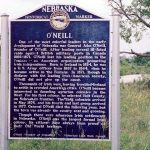
One of the most colorful leaders in the early development of Nebraska was General John O’Neill, founder of O’Neill. After leading several ill-fated raids against British military posts in Canada, 1866-1871, O’Neill lost his leading position in the Fenians--an American organization promoting Irish independence. Born in Ireland in 1834, he was a U. S. Army Officer from 1857 to 1864, when he became active in the Fenians. In 1871, though in disfavor with the leading Irish-American society, O’Neill did not give up the cause.
406 E Douglas St
O'Neill, NE
68763
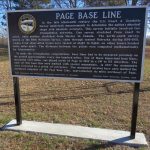
Page Base Line
In the late nineteenth century the U. S. Coast & Geodetic Survey undertook measurements to determine the nation’s physical shape with absolute accuracy. This survey initially involved two triangulation networks. One survey stretched from coast to coast, while another stretched from Mexico to Canada. The north-south survey, known as the 98th Meridian Survey, came through central Nebraska during 1898-1901. Angles from observation towers were turned at night to lights on other towers located many miles apart. The distances between the points were computed mathematically by trigonometry.
Page NE
68766
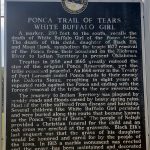
A marker, 200 feet to the south, recalls the death of White Buffalo Girl of the Ponca tribe. The death of this child, daughter of Black Elk and Moon Hawk, symbolizes the tragic 1877 removal of the Ponca from their homeland on the Niobrara River to Indian Territory in present Oklahoma.
Neligh NE
68756
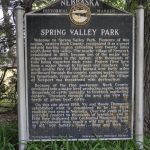
Welcome to Spring Valley Park. Pioneers of this region, eastern Rock County, recognized it as a great natural haying region extending over twenty miles south down this valley.
Newport, NE
68759
The Cheyenne Outbreak Historical Marketer
Harrison, NE
69346
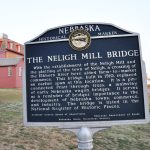
With the establishment of the Neligh Mill and the platting of the town of Neligh, a crossing of the Elkhorn River here aided farm-to-market commerce. This bridge, built in 1910, replaced an earlier span at this location. It is a pin-connected Pratt through truss, a mainstay of early Nebraska wagon bridges. It serves as a reminder of bridges’ importance to the development of Nebraska towns, commerce, and industry. The bridge is listed in the National Register of Historic Places.
Neligh, NE
68756
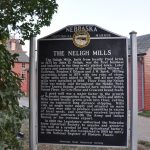
The Neligh Mills, built from locally fired brick in 1873 by John D. Neligh, was the first business and industry in the then newly platted town. Later owners and operators of the mill included William C. Galloway, Stephen F. Gilman and J. W. Spirk. Milling operations began in 1874 with two runs of stone. Roller mills were added in 1878, and all new roller mills were installed in 1898. Flour from the Neligh Mills was widely sold throughout the Middle West. Better known brands produced here include Neligh Patent Flour, So-Lite Flour and Crescent brand feeds.
Neligh, NE
68756
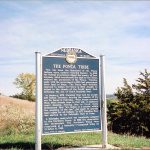
This has been the homeland of the Ponca Indians since earliest recorded history.
Niobrara, NE
68760
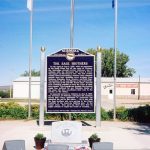
On the night of June 2, 1969, while on maneuvers in the South China Sea off the coast of Vietnam, the Australian aircraft carrier Melbourne was in collision with the destroyer USS Frank E. Evans.
Niobrara, NE
68760
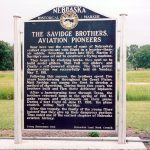
The Savidge Brothers, Aviation Pioneers
Near here was the scene of some of Nebraska’s earliest experiments with flight in a heavier-than-air vehicle. Sometime before late 1907, Martin P. Savidge’s sons set out to construct a flying machine.
They began by studying hawks, then went on to build model gliders, then full size gliders, and finally a self-powered airplane. The first public demonstration was successfully held on Sunday, May 7, 1911.
Ewing, NE
68735