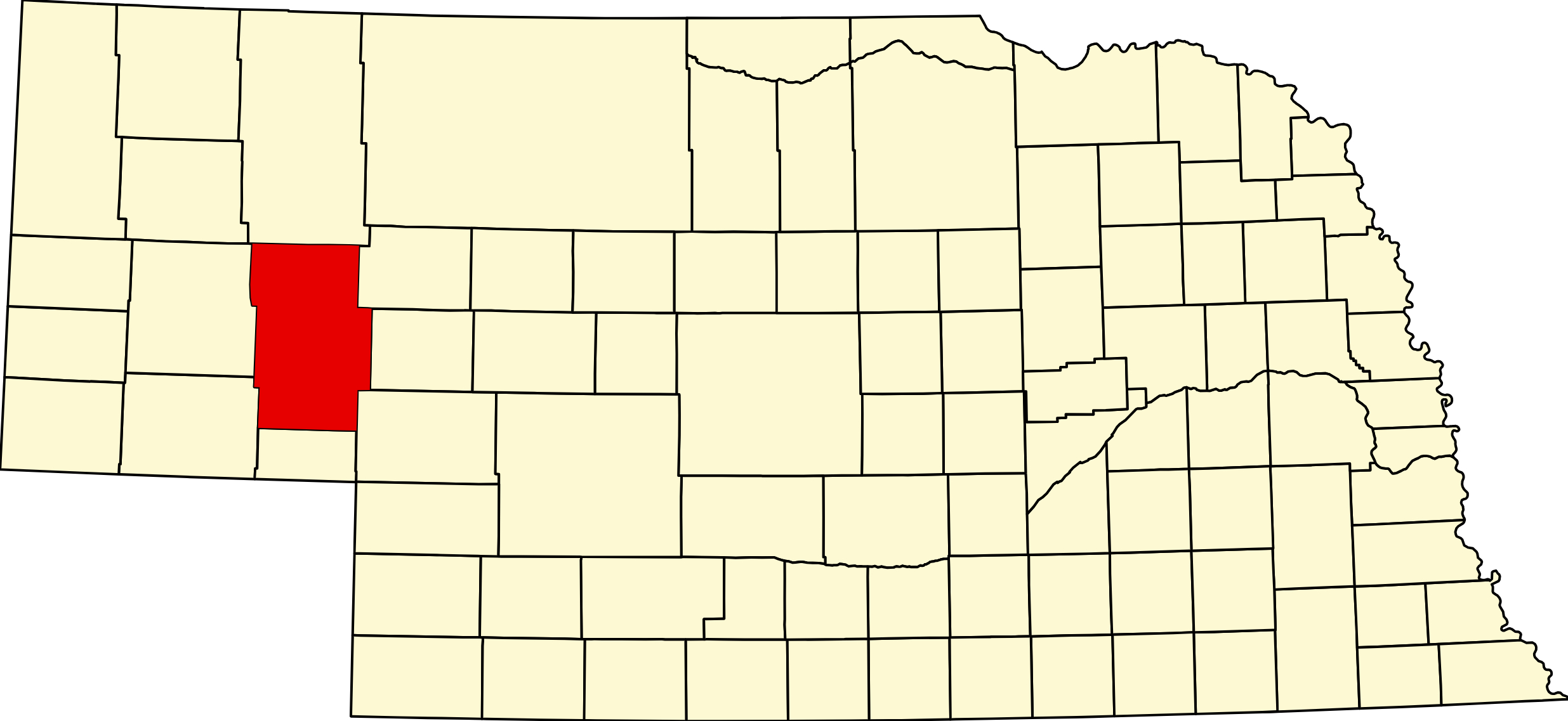
Garden County, Nebraska (Plate 77)

Visitor & Travel Categories
Business & Economic Categories
Garden County Cameras
Garden County, Nebraska
County Seat: Oshkosh
Founded: 1909
Named For: Its fertile land and early promotional slogan, “The Garden of the West”
License Plate Prefix: 77
Population: 1,874 (2020 census)
Area: 1,706 sq mi
History
Garden County was created in 1909 from the northern portion of Deuel County. Early boosters promoted the region as “The Garden of the West,” a name that reflected optimism about the area’s agricultural potential. Settlement grew along the North Platte River, where ranchers and homesteaders established operations across the wide-open prairie.
Oshkosh became the county seat and developed into a regional service center for ranching, farming, and transportation. The county’s history is closely tied to the Oregon Trail, with preserved trail ruts and historic markers found throughout the region. Ranching, dryland farming, and wildlife-rich landscapes continue to define Garden County’s identity.
Geography
Location: Western Nebraska along the North Platte River
Landscape: Sandhills, river valleys, prairie grasslands, and historic trail corridors
Adjacent Counties:
- Sheridan County (north)
- Morrill County (east)
- Deuel County (south)
- Cheyenne County (southwest)
- Kimball County (west)
- Banner County (west)
Culture & Landmarks
- Ash Hollow State Historical Park – A major Oregon Trail landmark with preserved wagon ruts and historic sites.
- Blue Creek & North Platte River Valley – Scenic areas supporting wildlife, ranching, and recreation.
- Lewellen & Oshkosh Heritage Sites – Local museums and historic buildings tied to early settlement.
Notable Communities
- Oshkosh – County seat and regional service center.
- Lewellen – Gateway to Ash Hollow and the Oregon Trail corridor.
- Lisco – Ranching community along the North Platte River.
- Madrid – Small rural settlement in the northern Sandhills.
Events & Attractions
- Oregon Trail Interpretive Sites – Historic markers, ruts, and educational programs.
- Outdoor Recreation – Hunting, fishing, birdwatching, and Sandhills exploration.
- Local Fairs & Community Events – Celebrations highlighting ranching, agriculture, and pioneer heritage.
Living in Garden County
Garden County offers a quiet rural lifestyle rooted in ranching, agriculture, and historic landscapes. Oshkosh and Lewellen provide essential services, while the county’s wide-open spaces support outdoor recreation and wildlife. Residents value the area’s peaceful pace, strong community ties, and deep connection to Nebraska’s frontier and trail history.
Outdoors — Camping, RV, Hunting & Fishing
Garden County has more public land than the rest of the southern Panhandle combined — a 45,000-acre national wildlife refuge, a state historical park on the Oregon Trail, and a wildlife management area at the head of Lake McConaughy. It is also the county the Morrill Fire hit hardest, and that has to shape any trip planned here in 2026.
Read this before visiting Crescent Lake. The Morrill Fire burned from 12 to 25 March 2026 across Keith, Arthur, Grant, Garden and Morrill counties — 642,029 acres, the largest wildfire in Nebraska history — and the vast majority of Crescent Lake National Wildlife Refuge burned. The Fish and Wildlife Service warns that refuge trails and roads may be impassable even with four-wheel drive. The refuge is open, but interior and off-road travel is discouraged. Take that seriously; this is remote country.
Crescent Lake National Wildlife Refuge. 10630 Road 181, Ellsworth; (308) 762-4893. Roughly 45,800 acres protected since 1931, holding the largest protected continuous sand dunes in the United States, a dozen small lakes and numerous ponds, about 200 bird species and as many as twenty pairs of bald eagles. Getting there: north from Oshkosh on West Second Street for 28 miles, following the refuge signs — allow an hour once the pavement ends. Open sunrise to sunset; office weekdays 8 to 4:30. The Ellsworth mailing address is a Sheridan County post office, but the refuge itself is in Garden County. No camping on the refuge.
Hunting at Crescent Lake: open 1 September through 15 March for mule and white-tailed deer, pronghorn (archery from 1 September), grouse and pheasant with non-toxic shot, migratory birds, and small game. Hunters may access from two hours before sunrise to two hours after sunset; anglers one hour either side. Temporary blinds and stands are allowed but must be removed daily. Prohibited: commercial guiding, alcohol, ATVs and UTVs, live or dead minnows, and shooting from vehicles.
Fishing at Crescent Lake: Island Lake (711 acres) holds bluegill, carp, crappie, largemouth bass, walleye and yellow perch, with three primitive launches. Smith Lake (225 acres) and Crane Lake (128 acres, which winterkills regularly) are the other refuge waters. Blue Lake (311 acres) is a private lake with a public easement reached by a 2.7-mile trail requiring four-wheel drive — daytime fishing only, no camping, hunting, ATVs, horses or fires. Motors: non-motorized on all open waters; electric only on Island, Smith and Crane; internal combustion only on Blue Lake, with a 5 mph no-wake limit. Seasons on the individual lakes vary between sources — check with the refuge before a winter trip.
Ash Hollow State Historical Park. 4265 US Highway 26, Lewellen; (308) 778-5651. On a bluff above the North Platte valley. Nine miles of hiking on four trails, including the climb to the summit of Windlass Hill, where the wagon-rut swales of the Oregon–California Trail are still visible in the ground — this is one of the best surviving trail traces anywhere. Ash Hollow Cave, where people camped for several thousand years, is protected behind glass in an interpretive centre.
- Visitor centre: 1 May to 30 October, 10 a.m. to 4 p.m. Mountain, Thursday through Monday. 1 November to 30 April by appointment only, (308) 778-7708.
- Fees: a park entry permit is required, and Game and Parks lists $5 for adults 13 and over, $1 for children 3–12. Other sources give different figures; call the park.
- No camping at Ash Hollow. The nearest is the Lewellen RV parks below, or the Lake McConaughy areas in Keith County.
- The Ash Hollow SP pond (0.6 acres) is stocked with rainbow trout for a youth event only.
Historical note: the Battle of Ash Hollow, also called Blue Water Creek, took place near modern Lewellen in September 1855, when Gen. William S. Harney and 600 troops made a surprise attack on a Brulé Lakota encampment under Chief Little Thunder: 86 killed and 70 captured. It is part of what happened here and deserves telling straight.
Clear Creek Wildlife Management Area. Where the North Platte enters Lake McConaughy, spanning the Garden and Keith county line — riparian woodland, wetland, river channel, lakebed and upland grassland. The eastern portion alone runs more than 3,200 acres. HQ (308) 778-5486. Species: deer, turkey, pheasant, dove and waterfowl.
- A special hunting area of about 300 acres holds ten four-person pit blinds. They are open to waterfowl and other game until the Monday before Thanksgiving; after that access is by daily drawing with a check-in at the check station. Up to five blinds can be reserved in advance — apply August to September for an October drawing. 18-shell limit per hunter, non-toxic shot only. After dark goose season the blinds go first come, first served.
- The Garden County Refuge unit allows deer hunting from 1 September through the Sunday before Thanksgiving.
- The Clear Creek seasonal refuge closes from the Monday before Thanksgiving through 14 February.
- Clear Creek was named in the March 2026 fire situation reports — verify habitat condition and any residual closures before you plan around it.
Lake McConaughy is in Keith County, not Garden County. Garden County’s own tourism material says so plainly. What legitimately belongs here is the north-shore approach from Lewellen on NE-92 — the lake is within twenty minutes — and Clear Creek WMA, which genuinely reaches into the county.
Campgrounds in Garden County
- Oregon Trail Campsite RV Park, 402 West Avenue A, Oshkosh — Gary Johnson (308) 778-6054 or Marie Johnson (308) 778-6962. 15 RV sites with hookups, 15/30/50 amp, water and sewer, and a public dump station available for a small fee. Tent sites, picnic tables, shade trees and grills; pets welcome. Self check-in, with daily, weekly, monthly and seasonal rates. On US-26, one block from a gas and convenience store. Harvesters welcome.
- Hwy 26 RV Park, 311 Home Street, Lewellen — 8 sites: 6 full hookups with 50 amp, 2 with water and 30 amp, plus tent and dry camping. Showers, laundry and restrooms, free Wi-Fi. Next to the city park with free summer swimming; two miles to Ash Hollow, twelve to Lake McConaughy.
- Oregon Trail RV Campground, 20130 US Highway 26, Lewellen; (970) 978-8186. 16 sites — 12 RV with water, septic and electric, and 4 tent. Laundry, restroom and shower access for all campers. Reservations by phone or on arrival.
Two of those names collide constantly in directories: Oregon Trail Campsite RV Park in Oshkosh and Oregon Trail RV Campground in Lewellen are different businesses about 25 miles apart.
A note for big rigs on WMA land: primitive camping is allowed on Nebraska WMAs unless posted otherwise, for up to 14 consecutive days in any 30-day period — but camping equipment is limited to 8 feet wide by 40 feet long, which rules out many coaches and fifth-wheels.
Garden County at a Glance
Garden County, Nebraska — created by popular vote on 2 November 1909, separating the northern three quarters of Deuel County. The name came from local real estate agents who argued the country could be the “garden spot of the west”. County seat Oshkosh, named for Oshkosh, Wisconsin, founded in the 1880s by cattlemen, reached by rail in 1908 and incorporated in 1910. Population peaked at 5,099 in 1930. 138 listings across 3 towns.
Getting there: US-26 and Highway 92 follow the North Platte through Lewellen, Oshkosh and Lisco; NE-27 runs north from I-80 at Exit 95. Garden County is off the Union Pacific main line — a branch reached Oshkosh in 1908. Mountain Time across the whole county.
For visitors: two landscapes in one county. The north is Nebraska Sandhills, and Crescent Lake National Wildlife Refuge protects roughly 45,800 acres of it — the largest protected continuous sand dunes in the United States, with a dozen lakes and about 200 bird species. The south is the North Platte valley, where Ash Hollow State Historical Park at Lewellen holds nine miles of trail and the wagon-rut swales of Windlass Hill, still cut into the ground where emigrants dropped into Ash Hollow. Clear Creek WMA reaches in from the Lake McConaughy end with more than 3,200 acres and ten pit blinds. This is the only county in the southern Panhandle with substantial public hunting ground.
Recent history visitors should know: the Morrill Fire of March 2026 — 642,029 acres, the largest in Nebraska history — burned across Garden County, and the vast majority of Crescent Lake refuge burned with it. The refuge is open, but its interior roads and trails may be impassable.
One thing the county’s own material gets wrong: Red Cloud was not born here. The Lakota leader was born near the forks of the Platte close to present-day North Platte, in Lincoln County, about a hundred miles east.
Garden County · Panhandle · Highway 92 Corridor · Explore Nebraska