
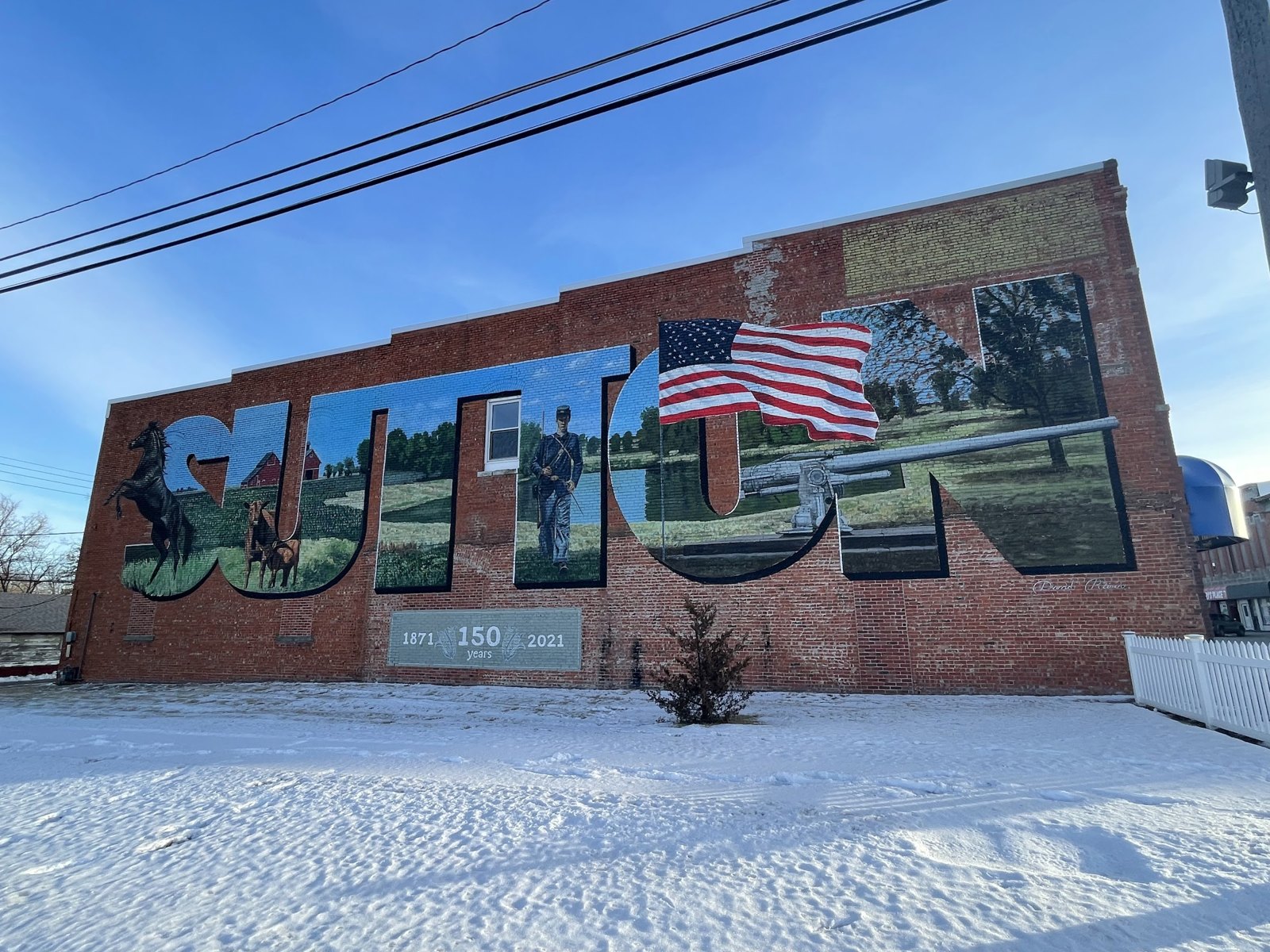
City · Clay County · Population 1,447 (2020 census) · ZIP 68979 · Founded 1871 · Peak population 1,702 (1910)
About Sutton
Sutton is a city of 1,447 people (2020), the largest in Clay County, at 1,677 feet on US 6 in the northeast of the county, about 12 miles east-northeast of Clay Center. I-80 is about 18 road miles north, and US 81 about 14 miles east. Sutton has its own K–12 public schools and a Christian school, a library, an outdoor pool, the Sutton Community Home, a city RV park on East Ash Street, the 9-hole Fox Hollow golf course and the weekly Clay County News. Sutton is on Central Time.
History
Luther French filed his claim on March 14, 1870, and lived in a dugout on School Creek; he laid out the town on August 10, 1871, and sold it that November to I. N. and M. Clark. It was named for Sutton, Massachusetts. The Burlington & Missouri River laid its first rails here on August 12, 1871, and a depot was built in the fall of 1873. Sutton was the county seat from the first election in 1871 until Clay Center won it in 1879. Germans from the Volga region of Russia began arriving in the fall of 1873, and a German Reformed church was organized in 1874; the Congregational church of 1875 was the first church building in the county. Sutton became a village in 1874 and a city in 1876, and peaked at 1,702 people in 1910. Jacob Volz, born in Balzer, Russia, and raised in Sutton, received the Medal of Honor for action in the Philippines in 1911.
Highways and trails through Sutton
| Route | One way | Other way |
|---|---|---|
| US 6Through the city | West to Harvard and Hastings | East to Grafton and Fairmont |
Nearby towns
| Saronville | about 4 mi west | US 6 and Spur 18G |
| Grafton | about 8 mi east-northeast | US 6 |
| Clay Center | about 12 mi west-southwest | US 6 and NE 14 |
| Harvard | about 12 mi west | US 6 |
| Fairmont | about 14 mi east | US 6 |
| Ong | about 14 mi south | County roads |
| Geneva | about 15 mi east-southeast | County roads |
| Shickley | about 15 mi south-southeast | County roads |
| Edgar | about 18 mi south-southwest | County roads |
| Hastings | about 28 mi west | US 6 |
Things to see
the Sutton Nebraska Museum, 309 N. Way Ave.: main museum, a restored 1908 house and a country school · the Isaac Newton Clark House, 468 Cedar St. (1877, National Register; private) · the Deering Bridge over School Creek, 2 miles north and 2 east (National Register) · Fox Hollow Golf Course (9 holes, public) · Hultine Waterfowl Production Area, 5 miles west · Dugout Days each June
Events in Sutton
- Dugout Days
Dugout Days is held in Sutton, Nebraska, on the last weekend of June (Thursday to Sunday).
Know of another event here? Tell us about it.
Schools and health care
Schools: Sutton Public Schools, 1107 N. Saunders Ave.: Sutton Elementary (PK–6), (402) 773-4423, and Sutton Secondary (7–12), (402) 773-4303; Sutton Christian School (K–8), 1004 E. Ash St., (402) 773-4845
Health care: Sutton Community Home, 1106 N. Saunders Ave., (402) 773-5557 (nursing home); nearest hospitals: York General, York, about 22 mi, and Mary Lanning Healthcare, Hastings, about 28 mi
Sources: U.S. Census; Wikipedia; Clay County (claycounty.ne.gov); City of Sutton; Andreas, History of the State of Nebraska (1882); Johnson, History of Nebraska (1880); Nebraska State Gazetteer (1890–91); NEGenWeb Clay County; Newberry Library county atlas; National Register (NRHP nominations); History Nebraska; HMdb; Nebraska Game and Parks; U.S. Fish and Wildlife Service (Rainwater Basin WMD); USDA-ARS; SABR; Visit Nebraska; SchoolDigger. Distances marked "about" are straight-line estimates.
Sutton Businesses & Places
64 listings in Sutton.
Click a category to see the businesses.
Eat & Drink (4)
- Maury's Place — Bar & Grill
- Subway – 107 E Hwy 6, Sutton — Subway
- Sutton Bakery — Bakery
- The Mustang Restaurant and Lounge — Bar & Grill
Stay (2)
- Fox Hollow Motel — Motel
- The Trail Inn — Motel
Outdoors & Recreation (3)
- Fox Hollow Golf Course — Golf Course
- Hultine Waterfowl Production Area — Public Hunting Areas & WMAs
- Sutton RV Park and Campground — Campgrounds & RV Parks
Places to Visit (1)
- Sutton Nebraska Museum — Specialty Museums
Events & Venues (1)
- Dugout Days — Festivals & Celebrations
Health & Emergency (8)
- Barbee Veterinary Clinic — Mixed / General Practice
- Clay County Physical Therapy — Physical Therapy
- South Central Chiropractic — Chiropractor
- Sutton Family Practice (Henderson Health Care) — Medical Clinic
- Sutton Pharmacy — Pharmacy
- Sutton Veterinary Clinic — Veterinarian
- Sutton Veterinary Clinic PC — Mixed / General Practice
- Sutton Vision Center — Optometrist
Travel Services (1)
Community & Faith (14)
- Calvary Cemetery — Cemeteries
- Chapel Grove Cemetery — Cemeteries
- Emmanuel Reformed Church Cemetery — Cemeteries
- Farmers Valley Cemetery — Cemeteries
- Federated Church UCC — Congregational Church
- Salem Church Cemetery — Cemeteries
- St. Mary Catholic Church Sutton — Catholic Church
- Sutton Cemetery — Cemeteries
- Verona Baptist Cemetery — Cemeteries
- Verona Cemetery — Cemeteries
- Verona Danish Cemetery — Cemeteries
- Verona Swedish Cemetery — Cemeteries
- Wolf Creek Cemetery — Cemeteries
- Zion Lutheran Church — Lutheran Church
Automotive (7)
- Action Auto Supply — Auto Parts
- Aspegren Repair — Auto Repair
- Becker Auto Sales — Used Car Dealer
- Friesen Chevrolet — Franchised New Car Dealer
- Nelsons 4 X 4 Center — Used Car Dealer
- Sutton Auto Sales — Used Car Dealer
- Sutton Body Shop — Auto Body Repair
Government & Resources (6)
- Sutton Community Home — Assisted Living
- Sutton Legion — Senior Citizen Center
- Sutton Memorial Library — Libraries
- Sutton Police Department — Police Station
- Sutton Post Office — Post Office
- The Bread Box Inc. — Food Pantry
Professional Services (5)
- Bergen Real Estate — Real Estate Agency
- Cornerstone Bank — Banking
- Cornerstone Insurance Group — Insurance
- Sutton Self Storage — Self-Storage Facility
- Waypoint Bank — Banking
Education (4)
- Sutton Christian School — Faith-Based School
- Sutton Elementary School — Elementary & Middle School
- Sutton Public Schools — School District (K-12 / General)
- Sutton Secondary School — Elementary & Middle School
Trades & Construction (3)
- Consolidated Concrete Co. — Ready Mix Concrete Supplier
- Sutton Electric — Electrical
- Sutton Lumber — Lumber
Manufacturing & Industrial (2)
- Central Nebraska Wood Preservers — Wood Products Manufacturing
- Fuehrer's Market Cheespred — Food & Beverage Manufacturing
Utilities (2)
- City of Sutton — Water Utility / District
- Sutton Municipal Utilities — Electric Power Provider
Media (1)
- Clay County News — News Paper