
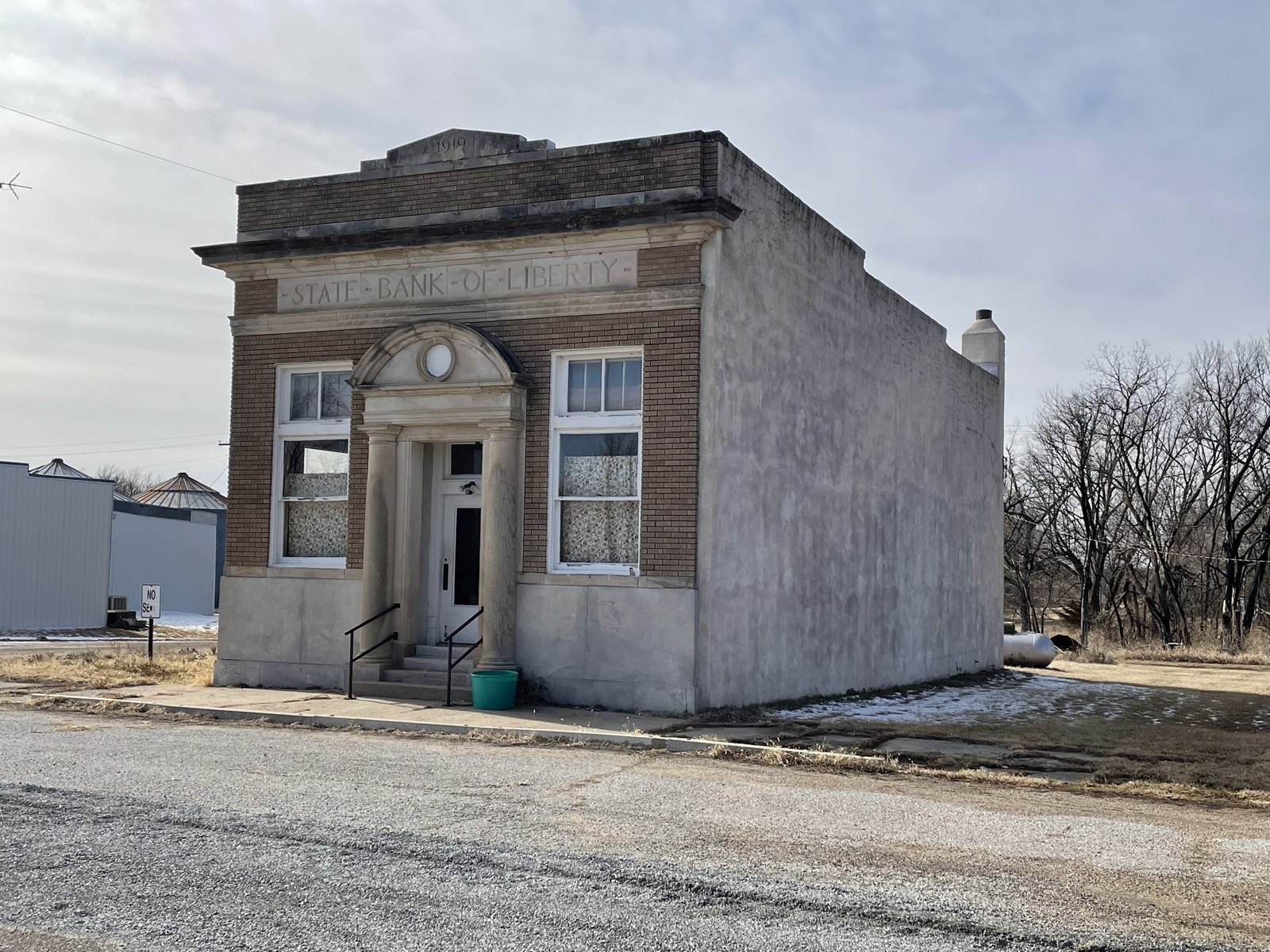
Village · Gage County · Population 37 (2020 census) · ZIP 68381 · Founded 1880 · Peak population 469 (1890)
About Liberty
Liberty is a village of 37 in southeastern Gage County, reached by spur S-34A about 2.6 miles north of NE 8, about 10 miles east-southeast of Wymore and near the Pawnee County line.
History
A Liberty post office opened in 1875 at C. S. Wymore's farm. When the Burlington & Missouri built through in 1880–81, N. D. Cain and F. M. Muchmore laid out town lots at the station, the post office moved in, and a Palmer opened the first grocery in April 1881; railroad crews dug up a mastodon skeleton nearby. The population peaked at 469 in 1890, and the Panic of 1893 hit the town hard. Kenneth S. Wherry, U.S. senator from 1943 to 1951 and Senate Republican leader, was born here in 1892.
Highways and trails through Liberty
| Route | One way | Other way |
|---|---|---|
| S-34ASpur into the village | South to NE 8 (about 2.6 mi) | Ends in Liberty |
Nearby towns
| Barneston | about 5 mi west-southwest | S-34A and NE 8 |
| Mission Creek | about 6 mi south-southeast | County roads |
| Burchard | about 8 mi east-northeast | County roads |
| Wymore | about 10 mi west-northwest | NE 8 and US 77 |
| Virginia | about 11 mi north | County roads |
| Pawnee City | about 18 mi east | NE 8 |
Things to see
Liberty Cemetery, 1 mi southwest · the former settlement of Mission Creek and its cemetery, about 6 mi south-southeast in Pawnee County · Burchard Lake, about 9 mi east-northeast
Health care
No clinic in Liberty; Wymore Medical Clinic, 116 E. H St., Wymore, 402-645-3310 (Beatrice Community Hospital); nearest hospital: Beatrice Community Hospital and Health Center, 4800 Hospital Pkwy. (US 77 North), Beatrice, 402-228-3344 (critical access hospital with a 24-hour emergency department)
Sources: U.S. Census; Wikipedia; Andreas, History of the State of Nebraska (1882); Dobbs, History of Gage County (1918); National Park Service; History Nebraska; National Register of Historic Places; Nebraska Game and Parks; Lower Big Blue NRD; Nebraska Department of Transportation; city, village, school, museum and hospital websites. Distances marked "about" are straight-line estimates.
Liberty Businesses & Places
3 listings in Liberty.
Click a category to see the businesses.
Community & Faith (2)
- Evangelical Lutheran Cemetery — Cemeteries
- Liberty Cemetery — Cemeteries
Utilities (1)
- Village of Liberty — Water Utility / District