
- Antelope County (3)
- Neligh (3)
- Boyd County (2)
- Brown County (2)
- Cherry County (1)
- Valentine (1)
- Holt County (6)
- Keya Paha County (1)
- Springview (1)
- Knox County (5)
- Rock County (1)
- Newport (1)
Nebraska Historical Marker proclaiming O'Neill the Irish Capital of Nebraska — established by the Irish colonists who settled the Elkhorn Valley in 1874.
O’Neill, Irish Capital of Nebraska
68763
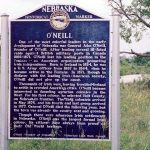
One of the most colorful leaders in the early development of Nebraska was General John O’Neill, founder of O’Neill. After leading several ill-fated raids against British military posts in Canada, 1866-1871, O’Neill lost his leading position in the Fenians--an American organization promoting Irish independence. Born in Ireland in 1834, he was a U. S. Army Officer from 1857 to 1864, when he became active in the Fenians. In 1871, though in disfavor with the leading Irish-American society, O’Neill did not give up the cause.
406 E Douglas St
O'Neill, NE
68763

In western Knox County, Nebraska, between the now ghost towns of Walnut and Venus, near the Grimton Cemetery, is the most impressive park of all, Oak View Park in Knox County at times attracted 10,000 to 30,000 people in a single day during the Depression era. It is the subject of a book written by Linda Wostrel, an Omaha historian.
Venus, Nebraska
68764
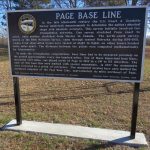
Page Base Line
In the late nineteenth century the U. S. Coast & Geodetic Survey undertook measurements to determine the nation’s physical shape with absolute accuracy. This survey initially involved two triangulation networks. One survey stretched from coast to coast, while another stretched from Mexico to Canada. The north-south survey, known as the 98th Meridian Survey, came through central Nebraska during 1898-1901. Angles from observation towers were turned at night to lights on other towers located many miles apart. The distances between the points were computed mathematically by trigonometry.
Page NE
68766
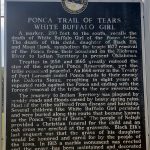
A marker, 200 feet to the south, recalls the death of White Buffalo Girl of the Ponca tribe. The death of this child, daughter of Black Elk and Moon Hawk, symbolizes the tragic 1877 removal of the Ponca from their homeland on the Niobrara River to Indian Territory in present Oklahoma.
Neligh NE
68756